



How to Decorate a Hall Tree: 10 Entryway Ideas That Actually Work
A hall tree does four jobs at once. Hooks for coats. A seat for pulling shoes on. Storage underneath. A shelf for keys and post.
Decorating one is easy to get wrong. Fill every surface with baskets and seasonal props, and you lose the storage that made you buy it.
This guide covers how to decorate a hall tree first, then ten hall tree ideas for different entryways. You also get hook heights, depth limits, and the safety step almost every guide skips.
The piece itself is old news. Victorian homes had hall stands that did exactly this job in the 1800s.
What a Hall Tree Does

A hall tree bundles several entryway pieces into one vertical unit. Coat rack, bench, shoe rack, shelf, sometimes a mirror.
The point is vertical efficiency. One footprint against one wall handles what four separate items would.
What It Should Hold
Only the things that move in and out with you daily:
- Coats and jackets in current rotation.
- Everyday shoes. Not the whole collection.
- Bags, backpacks, dog leads.
- Keys, sunglasses, post.
- An umbrella or two.
Everything else belongs in a closet. A hall tree stops working the moment it becomes long-term storage.
How to Decorate a Hall Tree Without Losing the Storage

Decorating comes after function, not instead of it. Six rules keep both.
Start With What You Use Every Day
Load the daily items first. Hang coats on hooks, put shoes in the cubbies, and drop keys in a dish.
Whatever space is left over is your decorating budget. Not the other way around.
Use Matching Baskets to Quiet the Clutter
Two or three baskets in the same material do more for a messy entryway than any amount of wall art. Gloves, scarves, dog gear, all hidden.
Match them to each other, not the wood. Woven seagrass or plain canvas both work.
Add One Soft Thing
A bench cushion or a folded throw softens what is otherwise a hard wooden box. Choose a removable, washable cover. Entryway seating takes wet coats, muddy shoes, and whatever comes in off the street, so it gets dirtier than most furniture in the house.
Keep the Bench Mostly Clear
A bench covered in cushions is a shelf, not a seat. Leave room for a person and a bag of groceries.
One cushion at one end. That is the whole allowance.
Go Easy on Greenery
One trailing plant on the top shelf reads natural. Three plants plus a garland plus a wreath reads like a display.
Entryways are usually dark, so pick something that tolerates low light.
Swap Seasonal Decor, Do Not Stack It
One small seasonal accent at a time. When the season ends, it leaves before the next one arrives.
This is where hall trees quietly fill up. A pumpkin in October becomes a pumpkin next to a wreath by December.
10 Hall Tree Ideas for Different Entryways
Each of these solves a different problem. Pick by your entryway, not by the photo you liked.
1. Bench and Hooks, the Everyday Setup

The most useful configuration there is. Seat, hooks above, shoe storage below, shelf on top.
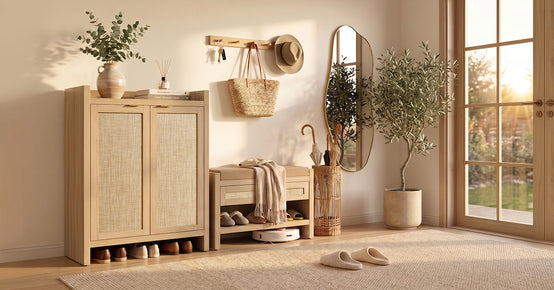
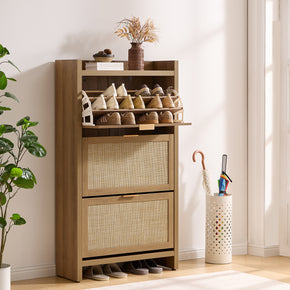
The bench does more work than people expect. Sitting to put shoes on beats hopping on one leg, especially with children. A rattan-front shoe bench gives you the seat plus ventilated storage, which matters for shoes that come in damp.
Best for family front doors and everyday entrances.
2. Hall Tree With a Mirror

A mirror turns the unit into a last-check station before you leave. It also bounces light into what is usually the darkest part of the house.
Keep the shelves near it fairly clear. A mirror reflects clutter as readily as it reflects light.
Best for small dark foyers and apartment entries.
3. Closed Shoe Storage for Visual Calm

Open cubbies are quick, but they show everything. Doors hide the mess entirely, which matters if the entry is visible from the living room.
The trade is airflow. Damp shoes need ventilation, so leave wet boots out overnight before they go behind a door. Browsing shoe storage cabinets and benches side by side makes the open-versus-closed choice easier.
Best for busy households and anyone who hates looking at shoes.
4. Farmhouse Hall Tree With Warm Wood

Painted frame, natural timber bench, black metal hooks, woven baskets. The combination is popular because it hides wear well.
Skip the decorative signs. Wood, woven fiber, and one muted textile is enough.
Best for farmhouse, cottage, and relaxed family homes.
5. Modern Minimalist Hall Tree

Clean lines, simple hooks, no ornament. The storage does the talking.
Closed fronts suit this look better than open shelving. A white shoe cabinet with closed doors beside a plain hook rail gives you the same functions as a bulky all-in-one unit, without the visual weight.
Best for contemporary, Scandi, and Japandi interiors.
6. Industrial Wood and Metal

A metal frame with timber shelves. Open construction makes a large unit feel lighter than a solid wooden one of the same size.
Pair with black hooks and wire baskets. Leather accents if you want warmth.
Best for lofts, urban apartments, and open-plan entries.
7. Narrow Hall Tree for a Tight Entryway

Depth matters more than width here, and the arithmetic is simple. Measure the clear width of the hallway wall to wall. Subtract the depth of the unit you are considering. What is left is what you will be walking through.
Compare that figure against the clearance you need rather than against a general rule. Doors swinging into the hallway take their own space. A wheelchair or walker needs considerably more than a person on foot, and local building rules may set a minimum, particularly on anything serving as an escape route.
Measure with the doors and drawers open. A cabinet door swinging into a narrow hall eats far more than the cabinet depth suggests.
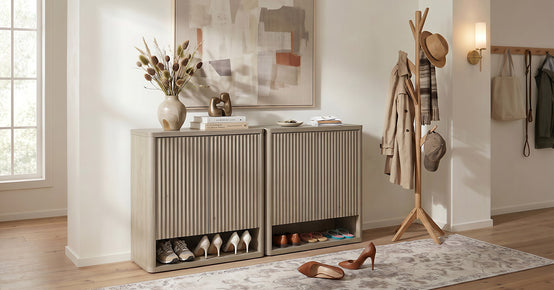
Go tall and shallow instead. A two-door hallway shoe cabinet paired with a wall-mounted hook rail delivers full hall-tree function in a strip of floor barely a foot deep.
Best for apartments, narrow halls, and small foyers.
8. Corner Hall Tree for Awkward Layouts

Corners near front doors usually sit empty. A corner unit turns dead space into hooks and a seat without claiming a whole wall.
These tend to be deeper than flat-backed units, which helps storage but takes up more floor space. Measure the diagonal.
Best for compact mudrooms and oddly shaped entries.
9. Build Your Own From Separate Pieces

A hall tree doesn't need to be a single purchased unit. Bench, backing board, hook rail, upper shelf. Four parts, same result.
Renters can skip the backing board and mount a hook rail instead. Settinga two-door cabinet with adjustable shelves under a row of hooks creates a deconstructed hall tree that moves with you. Use the cabinet for storage, not seating.
Sitting down to put shoes on needs a piece built for it. A cabinet top isn't rated as seating unless the maker says so, and a published seat load rating tells you. A shoe bench is the piece designed for that job.
Repeat one finish across the separate pieces so they read as one unit.
Best for DIYers, renters, and tight budgets.
10. Reclaimed or Antique-Style Hall Tree

An old door, a salvaged bench, vintage hooks. Character-driven, and often possible with pieces you already own or find locally.
Screen anything old before you build with it. Painted wood from before 1978 may carry lead, so leave the paint intact rather than sanding or stripping it. Check for hidden screws, nails, and old fixings, especially if you plan to cut. Check the structure itself for rot, worm damage, and splits along the grain.
Hooks need a sound substrate underneath. A weathered board that looks fine can be soft where a screw has to bite, and loaded coat hooks pull hard. Test what you are fixing into before you trust it with a wet winter coat.
Old pieces often lack shoe storage, since Victorian halls were built for hats and umbrellas. Add a basket or a boot tray underneath.
Best for cottage, eclectic and heritage homes.
Get the Measurements Right First
Most hall tree regrets are measurement problems, not style problems.
Hook Height by Who Uses Them
This is the number nobody publishes. Rough guide:
- Adult coat hooks. A common range is around 60 to 66 inches from the floor.
- Children. 36 to 42 inches, so they can actually reach.
- A second low row for bags and dog leads sits well around 48 inches.
Those figures are a starting point. Long coats need more clearance off the floor than jackets do. Reach varies with height, and hooks that need to work from a seated position or for a wheelchair user come down considerably.
Hold a hook at the height you are considering and hang your longest coat from it; where the hem lands tells you more than the number does.
Check the bench before you drill. A hook directly above a seat needs enough height for a hanging coat to clear whoever is sitting there.
Follow the mounting instructions that came with the hooks. Loaded coat hooks pull hard on a wall, and the fixings have to match what is behind the plaster.
Hang a coat on a hook at your planned height before drilling. If the hem drags on the bench, go higher.
Depth Is the Real Constraint
Width gets all the attention. Depth is what ruins a hallway. Measure from the deepest point, which is usually a basket edge or an open door rather than the cabinet carcass.
For a main walking route, thestandard for accessible walking surfaces sets a clear width of 36 inches. That rule governs public buildings rather than homes, though it is the firmest benchmark available for a route someone uses every day.
Design guidance often runs a little lower for comfort in tight homes. Treat that as a layout preference. Local building rules set their own minimums, and you should check anything serving as an escape route rather than estimate.
There Is No Standard Height
Hall trees run anywhere from about 60 inches to nearly ceiling height. No single number applies.
Compare the total height to your ceiling, then check that the hooks are reachable by the shortest person using them.
Check the Door Swing
Open your front door fully and mark where it stops. Plenty of hall trees fit the wall and still block the door.
Anchor It Before You Load It
A tall hall tree is exactly the shape that tips: narrow base, weight up high, children climbing on the bench.
The CPSC Anchor It campaign reports that anchoring has cut tip-over injuries and deaths by nearly half across ten years. Hall trees rarely get mentioned in that conversation, but the physics are the same.
A federal stability standard now applies to clothing storage units under the STURDY Act, and you can read what the rule covers. Hall trees sit outside it, which is more reason to strap yours.
Anchoring is not a solved problem. Consumer Reports has coveredwhere anchors and standards fall short, which is worth reading before assuming a kit does the job.
Match the fastener to the wall and to the product. Follow the instructions that came with the furniture, since the maker specifies hardware for the weight involved. Drywall, plaster, and masonry each take different fixings, and studs are different again.
A stud provides the strongest hold when available and when the hardware suits it. That doesn't mean drywall anchors never work, since some are rated for real loads. The rating on the packet is what matters.
Bring in a qualified installer if you are unsure about the wall or the weight. Guessing at fixings is how anchoring fails quietly: the hardware is in place, but nothing holds it.
One more check. Most affordable units use engineered wood, which must be labeled TSCA Title VI compliant when sold in the US.
Plan for Wet and Dirty Shoes
Every hall tree guide shows dry shoes in a clean cubby. Real entryways get rain and mud.
- Put a boot tray with a raised lip in the bottom cubby.
- Leave wet shoes on an open shelf overnight before they go behind a door.
- Pick a wipeable finish for the lowest surfaces.
- Choose rattan or slatted fronts where airflow matters more than hiding things.
Damp shoes in a sealed cabinet is how entryways start to smell.
Where Should a Hall Tree Go?

Put it wherever coats and shoes already pile up. That spot is telling you something.
Front entries, mudrooms, back doors, garage entrances, and apartment foyers all work. Matching the piece to the traffic matters more than matching it to the room, so start by looking for entryway furniture built for dailytraffic.
Avoid blocking doors, stairs, vents, radiators, or electrical panels. A hall tree that narrows the route gets resented within a week.
No dedicated entry? A compact unit works in a bedroom corner or beside a laundry door.
Common Hall Tree Mistakes
Five errors turn a useful piece into a cluttered one.
Buying on width alone. Depth and door swing decide whether it actually fits.
Too few hooks. Count the people, then count the bags they carry, then add two.
Making every shelf decorative. Storage furniture should still store things.
Ignoring wet shoes. No tray means a damp patch and a smell by February.
Burying the bench. Once nobody can sit on it, you have bought an expensive shelf.
What Not to Put on a Hall Tree
- Out-of-season coats. They belong in a closet.
- The full shoe collection. Daily pairs only.
- Anything heavy on the top shelf, which raises the tipping risk.
- Fragile decor within reach of a swinging backpack.
- Paperwork and post that never gets sorted.
The Short Version
Function first, decoration second. Load the coats, shoes, bags, and keys, then decorate with whatever space remains.
Measure depth and door swing before width. Set hook heights around the people using them. Strap it to the wall before you fill it.
The best hall tree is not the one with the most cubbies. It is the one where everything used at the door has an obvious place to go.
FAQs
Are hall trees a good idea?
Yes, when your entryway needs coat, shoe, and bag storage in one compact footprint. They replace a separate coat rack, bench, and shoe rack while using a single wall. The catch is matching the size to your actual storage load rather than filling a blank wall.
How to style a hall tree?
Work in this order:
- Hang the coats and bags you use daily.
- Fill the lower cubbies with everyday shoes.
- Add two or three matching baskets for small items.
- Put one cushion or throw on the bench.
- Finish with one plant, one tray, or one framed piece. Stop there.
How do I make my own hall tree?
The simplest build is a bench, a backing board, a hook rail, and an upper shelf. Repurposed bases work well—old benches, nightstands, small tables, dresser bases. An interior door or reclaimed boards make a good back. Fix the rail into studs, since hooks take a lot of force.
What are the different styles of hall trees?
Modern, minimalist, farmhouse and rustic. Industrial, traditional, antique. Reclaimed wood, open-back, corner and locker style. Style and function are separate decisions, though. A modern hall tree can still have a bench, closed shoe storage, and cubbies underneath.
Where to put a hall tree?
Near whichever door your household actually uses. Front entries and mudrooms. Back doors, garage entrances, apartment foyers. Keep it clear of door swings, stairs, vents, and radiators. Homes without a real entry can put a compact unit in a bedroom corner instead.
What is the standard height of a hall tree?
There is no universal standard. Designs run from roughly 60 inches up to near ceiling height. Compare the total height against your ceiling rather than hunting for one figure. Hook height matters more anyway. Around 60 to 66 inches suits adults, and 36 to 42 inches works for children.
What is the purpose of a hall tree?
It creates one station for everything that travels in and out with you. Coats, shoes, bags, keys, umbrellas. Each gets a fixed place, which stops them from spreading through the rest of the house. Models with benches add seating for putting shoes on.
What is another name for a hall tree?
Hall stand, coat tree, hat rack, hat tree, coat rack, entryway organizer. All describe similar pieces. The older term is hall stand, which dates to Victorian homes. Several of those names cover simpler units without the bench or shoe storage a full hall tree includes.
Sources
- Antique Trader – Furniture Detective: Hall Stands, Not Just a Place to Hang Your Coat
- U.S. Consumer Product Safety Commission – Anchor It Campaign Marks 10 Years of Fewer Furniture Tip-Overs
- AnchorIt.gov – CPSC Adopts Final Safety Standard to Prevent Tip-Overs of Clothing Storage Units
- Consumer Reports – Furniture Anchors Are Not an Easy Fix as Child Tip-Over Deaths Persist
- Style by Emily Henderson – Living Room Rules Worth Knowing
- U.S. Environmental Protection Agency – Formaldehyde Emission Standards for Composite Wood Products


Looking for something else?
How to Choose Dinnerware: The Ultimate Dinnerware Sets Buying Guide
LEARN MORE
Velvet 101: How to Care for Velvet (Complete Care Guide)
LEARN MORE
How to Decorate a Narrow Bedroom: 13 Narrow Bedroom Ideas and Layout Tips
LEARN MORE
How to Make a Coastal Centerpiece: Easy DIY Ideas
LEARN MORELooking for something else?
How to Make the Most of Your Hutch: Styling & Organization Ideas
LEARN MORE
How to Decorate a Small Kitchen: Design & Storage Tips
LEARN MORE
Sunbrella Fabric 101: What Is Sunbrella & Why It Lasts
LEARN MORE


Further reading
How to Decorate a Hall Tree: 10 Entryway Ideas That Actually Work

What Is Reclaimed Wood? Sources, Benefits, Risks and Buying Tips


