




Feng Shui Dining Room: 13 Practical Tips for Layout, Energy, and Abundance
A feng shui dining room asks one thing of you: treat the space where you eat as if it matters. Because in feng shui, it does — the dining table stands for nourishment, family, and abundance, and the whole room gets read as a signal of how well the household is fed. The shape of the table changes the energy. So does mirror placement. Chair count, color, light, all of it. These 13 feng shui dining room rules are the ones experts keep repeating, as covered inthis Livingetc guide, and they hold up for a reason. Most cost nothing to apply. Below you'll find the ideal feng shui dining room layout, the best dining room colors, where to hang a mirror, and the mistakes that quietly block good energy.
What Is Feng Shui, Exactly?

Feng shui is anancient Chinese practice of arranging buildings and rooms in harmony with qi — chi, if you prefer — the life force believed to run through everything. The name translates to wind and water. Two things that never stop moving. That's the core of it: a room with good feng shui lets energy travel through the way air or water would. No traps. No dead corners. No straight shot out the door.
Don't believe in chi? You don't have to. Strip the mysticism away, and most feng shui principles still hold up as plain design sense. A table with room to walk around it feels better than one wedged against a wall — anyone who's hosted Thanksgiving in a tight room already knows this. A clutter-free dining room makes people want to stay. Take the energy talk or leave it. The comfort part is real either way. That's exactly why feng shui principles for a dining room are worth knowing—they turn a vague sense of "this room feels right" into specific, repeatable moves for your own layout.
What the Dining Room Represents in Feng Shui
The dining room carries the feng shui assignment of abundance and prosperity, and the logic behind it is old and pretty literal. Food on the table means the household has enough, so the room where food appears becomes the symbol of having enough. It's also the gathering room—for family and friends, slow meals, and the conversations that don't happen anywhere else in the house. The practice of balancing yin and yang energy matters here more than in most rooms because this one swings hard: packed and loud at 7 p.m., silent and empty by 9.
Hold onto that meaning while you read the tips. Every single one traces back to it. Protect the table, honor the food, and make people feel safe enough to linger.
13 Feng Shui Dining Room Tips That Actually Work
1. Choose a Round or Oval Dining Table

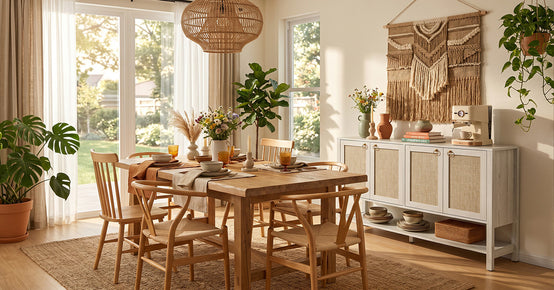
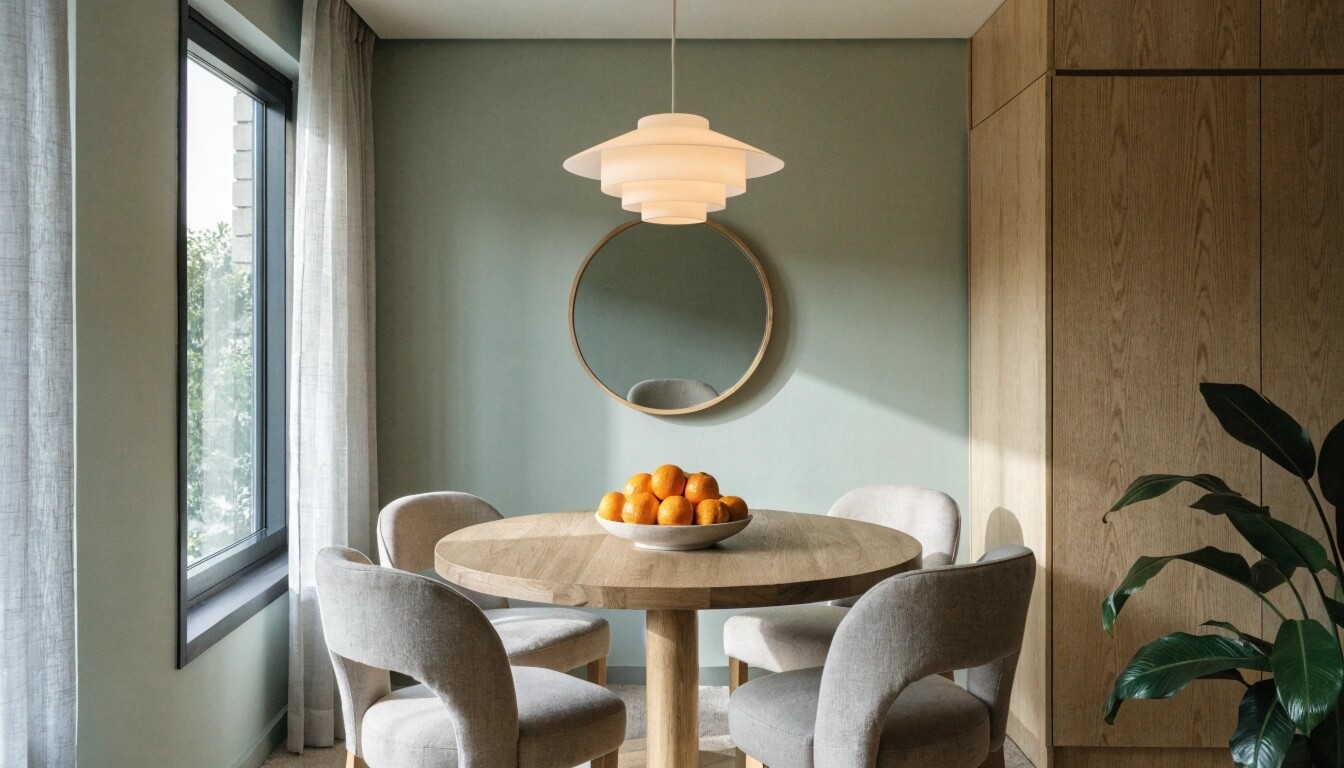
Walk into a feng shui consultant's own home and odds are good you'll find a round dining table. Curved edges let the flow of chi slide around the table rather than snag on corners. Sharp corners do the opposite — practitioners call them poison arrows, cutting energy aimed straight at whoever drew the unlucky seat. A round dining table fixes something social, too. No head of the table, no corner seat. Everyone faces to face, and conversation actually moves. An oval dining table gives you the same softness with a little more surface area.
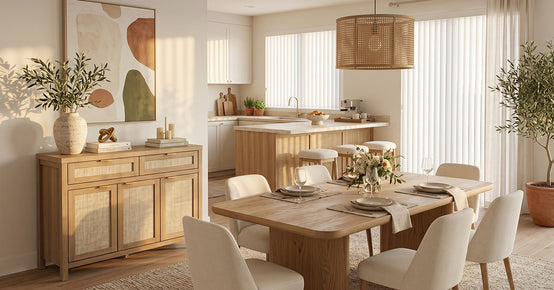
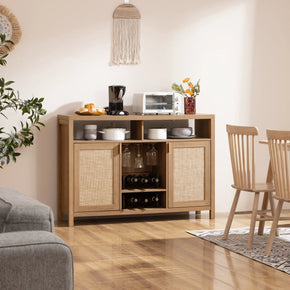
Got a rectangular table you love? Keep it. A runner softens the surface, a low centerpiece breaks up the hard lines, and chairs with rounded backs handle the rest. You can echo the curve elsewhere in the room, too — the Savanna Buffet Cabinet with 2 Arched Doors puts arched lines on the storage wall without you replacing a thing.
2. Pick a Solid Wood Table Over Glass

Wood wins. A wooden dining table brings the wood element into the room, which feng shui ties to growth, stability, and calm — and honestly, the grain does half the work on its own: oak, walnut, acacia, teak. Pick whichever one your budget likes.
Glass tabletops are the piece that feng shui keeps warning people about—fragile, ungrounded, a little cold. There's a practical complaint buried in there as well: glass shows every fingerprint, every water ring, every smudge from a kid's palm. Attached to yours anyway? Anchor it. Heavy wood base, woven placemats, enough natural materials stacked around the room that the glass stops dominating.
3. Place the Table in the Command Position

Center the table. The ideal feng shui dining room layout leaves walking space on every side. Aim for at least 36 inches between the table edge and the nearest wall—that's roughly what a pulled-out chair needs. When people can reach their seats without turning sideways, energy circulates in the same easy way it does.
One more placement rule, and it's a big one: never line the table up with the front door. A straight run from table entry creates what practitioners call a chi rush — the room feels hurried, and you can't quite name why. Shift the table off-axis. Or break the sightline with a console, a tall plant, a folding screen. Whatever the floor plan will give you.
4. Keep Every Seat Away From a Direct Door Line

Sit with your back to a door, and some old part of your brain stays on guard through the whole meal. You can't fully relax when you can't see who's coming. That's not superstition, that's wiring — feng shui just turned the instinct into a rule. Every diner either faces the entrance or gets a solid wall behind them. Support and security, in furniture form.
Test it yourself. Sit in each chair at your own table for thirty seconds. The exposed seats announce themselves fast. Nudge the table a foot, angle it slightly, or park a tall plant behind the worst chair — a decent stand-in when there's no wall to offer.
5. Use an Even Number of Dining Chairs

Count your chairs. Even numbers — two, four, six, eight — read as balance and pairing in feng shui. An odd count leaves one seat visually stranded, and the room ends up lopsided in a way guests notice without ever naming it. I didn't quite buy this rule until I saw a seven-chair setup in person. That odd chair really does throw the table off balance—your eye keeps landing on it. For feng shui dining room balance, an even number of chairs simply settles the whole arrangement.
Comfort carries equal weight. Comfortable dining chairs matter in feng shui because the point of this room is to keep people at the table. High backs add that protected feeling. Cold metal seats that empty the room in twenty minutes undo everything else you've done.
6. Hang a Mirror That Reflects the Table

Memorize one mirror rule, because it flips the bedroom rule on its head: in this room, the mirror should reflect the table. So, where should a mirror be placed in a dining room in feng shui? Hang it on a wall where it directly reflects the dining table. Food symbolizes abundance, so a dining room mirror that reflects the table symbolically doubles the meal—and the prosperity that accompanies it. Practitioners have been repeating this one for centuries.
Go round or oval, wood frame, hung where it genuinely catches the tabletop — centering the mirror around 57 to 60 inches off the floor usually lands it right. These mirror placement tips come with one warning worth taking seriously: a mirror doubles whatever it faces. Aim one at a mail pile or a bathroom door, and you've doubled exactly the wrong thing.
7. Stick With Calm, Earthy Dining Room Colors

Earth and wood tones own this room. The best feng shui colors for a dining room sit in the warm beige, soft brown, clay, sage, and muted green family — grounding shades that make food look good and people feel settled. Green pulls double duty: it connects to the family area of the bagua map, which is exactly the energy a shared-meal room wants. Something like Sherwin-Williams Clary Sage or Benjamin Moore Saybrook Sage hits the muted-green note without going dark.
Red is a spice, not a base. It's the fire element — warm, lively, lucky — and exhausting at full-wall scale—a red tablecloth, a touch of red in the dining room wall art, done. White, on its own, leans cold and metallic, though it makes a clean canvas once wood and plants warm it up. A feng shui color guide can help you match each shade to the element you're actually after.
8. Layer Soft, Warm Lighting

Kill the single overhead light. One bright fixture blasting the table is the cafeteria look, and it makes meals feel rushed even when nobody is rushing. Soft lighting in layers does the opposite. A dimmable pendant over the table. A small lamp on the sideboard. Candles when dinner deserves them. Warm bulbs only — 2700K is the sweet spot, and anything cooler starts feeling like an office.
Daylight counts as a layer, too. Clean windows, curtains open, let the room breathe during daytime hours. A dining area that never sees sun goes stale, energetically and otherwise.
9. Bring in Natural Materials and Plants

Texture is half of feng shui. Wood, linen, cotton, rattan, ceramic, and a living plant — every natural element grounds the room a little more. Plants come with one rule attached: soft, rounded leaves only. Pothos and jade thrive in dining rooms and carry gentle energy. Cacti point the same cutting energy at the room that sharp table corners do, so leave them in the office.
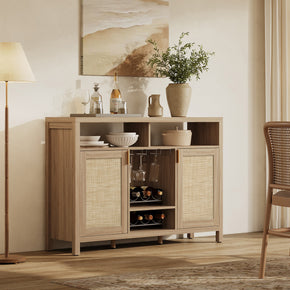
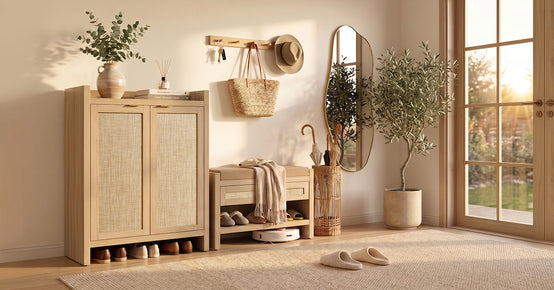
Storage can join the texture game rather than fight it. The Terra Cabinet with Storage fronts its doors in handwoven rattan — a natural material on display, table clutter hidden behind it. Two feng shui wins in one piece.
10. Keep a Fruit Bowl on the Table for Abundance

Fill a bowl with fruit and leave it on the table. That's it — the cheapest abundance cure in all of feng shui. Oranges are the classic, tied to wealth in tradition, but apples, grapes, and peaches all carry the message. Fresh food on permanent display tells the room, and everyone in it, that there is always enough. When bugs make real fruit a hassle, a still-life of food or a harvest scene works as dining room wall art and says the same thing.
Hosting is abundant, too, by the way. Giving the drinks setup its own home — something like the Savanna Bar Cabinet with Glass Holder — keeps generosity ready to pour without crowding the table surface.
11. Keep the Dining Area Clutter-Free

The dining table is a clutter magnet. Mail lands there first. Then a laptop. Then homework, car keys, and the online return that never got returned. And clutter is the fastest energy-blocker there is — a buried table tells the whole house this room is a dumping ground, not a gathering place. The clutter-free dining room isn't a nice-to-have in feng shui. It's the foundation on which everything else sits.
Closed storage beats willpower every single time. Sideboards and buffet cabinets hide the daily pile behind a door so it disappears, turning clearing the table into a thirty-second job instead of a Sunday project.
12. Never Place the Table Under Exposed Beams

Exposed beams press down. That's the feng shui reading — heavy, oppressive energy bearing on whoever sits underneath — and an hour-long dinner under a beam gives people the full dose. If the room allows it, slide the table out from under.
When it doesn't, cheat the eye instead, paint the beam the same white as the ceiling, and it visually dissolves. Fabric draped along its length softens it; a false ceiling erases it in stubborn rooms. You're not removing the beam. You're removing the weight.
13. Keep a Clear Path Between the Kitchen and Dining Area

The kitchen and dining area work like a relay team — one prepares the nourishment, the other receives it. Feng shui wants the handoff to be short and clean: a clear path between the two rooms, with the table close to the kitchen but offset from the direct line of the kitchen's door. Hot food arrives hot. Energy moves the way the food does.
Audit the route once. Stray chairs, a basket that migrated, the dog bed that crept into the walkway — clear all of it. A clean path is the least glamorous tip on this list and probably the one you'll use most.
The Ideal Feng Shui Dining Room Layout at a Glance

Put it all together, and the picture is simple. Table centered, with air on every side. No back to a door. Even chairs. A mirror catches the tabletop: soft lighting overhead, fruit in the middle, a clear run to the kitchen.
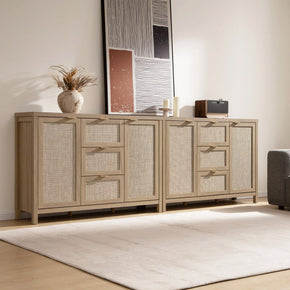
Storage stays on the wall, out of the table's orbit — a piece like the Cas Sideboard with 2 Doors and 3 Drawers absorbs everything the table shouldn't hold. Nothing under a beam. Nothing aimed at the front door. That's the whole feng shui dining room layout, and every tip above is one brushstroke of it.
Which Direction Is Best for a Dining Room?
Direction is the question everyone asks and the factor that matters least. Still, the traditions assign meaning to each one. East-facing dining rooms tie to family and health. South brings warmth, recognition, and strong natural light. West suits social energy and long dinners with friends. North leans toward career energy, which is why it's the least common pick for an eating space.
The honest part: almost nobody gets to choose their room's compass direction. For a feng shui dining room, the light, the colors, the layout, and how clutter-free the space stays matter far more than which way the room faces—and those are the levers you actually control.
Final Takeaway

None of this requires a renovation. These feng shui dining room layout tips come down to small moves anyone can make. Warm the light. Clear the surface. Hang the mirror where it reflects the table, and give every chair a protected back. An afternoon of shuffling furniture, maybe one can of paint, and the room reads differently by dinnertime.
Start with whichever tip stung a little when you read it — that's usually the one your room is missing. And when the gap turns out to be a dining room, the Sicotas dining room furniture collection covers sideboards, buffet cabinets, and storage built for exactly this kind of space.
FAQs
What does the dining room represent in Feng Shui?
Nourishment, family unity, and abundance. The household gets fed here, so feng shui reads the room as a direct prosperity signal — a cared-for dining room says there is always enough.
Which direction is good for dining?
East ties to family and health, south to warmth and recognition, west to social connection. All three work fine. Light, layout, and a clutter-free table will do more for the room than any compass reading.
Is it bad Feng Shui to see a dining table from the front door?
Seeing it isn't the issue — a dead-straight line from the front door to the table is. That alignment creates rushed energy. A console, a plant, a rug, or a small diagonal shift of the table breaks the line and solves it.
Is it good Feng Shui to have a mirror in the dining room?
Yes — this is one of the few rooms where feng shui actively wants a mirror. One that reflects the dining table is believed to double the food on it, and the abundance that comes with it.
Why do people put mirrors in their dining room?
Three reasons: more light bounced around the room, a small dining area that reads larger, and the symbolic doubling of whatever sits on the table. A round mirror in a wood frame delivers all three with the softest energy.
What is the best color for a dining room in Feng Shui?
Earthy, grounding shades — warm beige, soft brown, sage, and muted green. Green brings family energy. Red stays an accent. White works as a base once wood and plants warm it up.
Where should a mirror be placed in a dining room?
On a wall where it clearly catches the dining table, a centerpiece, or a window light. Keep it away from anything you'd hate to double — clutter, doorways, empty corners.
Sources
- Livingetc – 10 Feng Shui Dining Room Rules That Will Make Your Space Naturally Feel So Much More Comfortable
- Britannica – Feng Shui | Meaning, Definition, Facts, & Chinese Religion
- National Geographic Education – Feng Shui
- Homes & Gardens – Feng Shui Table Decor Rules: How to Arrange a Dining Table
- It's My Nest – 19 Feng Shui Dining Room Tips That Will Make Your Space Feel Instantly Cozier
- Paintzen – A Guide to Feng Shui Colors in Your Home


Looking for something else?

Furniture Materials Guide: Picking the Right Material Room by Room
LEARN MORE
How to Mix Wood Tones Without Making a Room Look Mismatched
LEARN MORE
18 College Apartment Furniture Ideas That Save Space and Money
LEARN MORE
Types of Entertainment Centers: 11 Designs and How to Pick One
LEARN MORELooking for something else?

Curio Cabinet Decor Ideas: How to Style a Display Cabinet Without the Clutter
LEARN MORE
Curved Furniture: How to Style, Measure, and Buy It in 2026
LEARN MORE
What Is Rattan Furniture? A Buyer Guide to Types and Care
LEARN MORE


Further reading

How to Choose a Nightstand for a CPAP Machine
The machine is the smallest part of the problem. A CPAP sits on maybe ten inches of tabletop, and then the humidifier tub has to slide out to be filled, the tubing and power cord leave from the ba...

How to Choose a Shoe Cabinet for Men's Sizes, High-Tops, and Bulky Shoes
A cabinet can advertise room for thirty pairs and still refuse your largest shoe. The pair count on a product card was calculated with some shoe in mind, and if that shoe was an average low-profil...

How to Choose a TV Stand That Fits a Soundbar
Width is the first thing people check and the least likely thing to go wrong. A soundbar that fits the top of a TV stand can still cover the bottom of the picture, block the remote sensor, sit too...


