




End Table Decor Ideas: How to Style a Living Room Table Beautifully
End tables are the easiest piece of furniture in any living room to underestimate. Most homes have one or two of them, most people barely look at them, and most styled-room photos you scroll past on Pinterest are doing more work on the end tables than you’d notice at a glance. The best end table decor ideas share a few habits in common: function first, varied heights, breathing room, and at least one thing that's actually yours.This BHG end table styling guide collects plenty of inspiration shots if you want a visual starting point. Below are 36 ways to style a living room end table that won't bore you in three weeks. Plus quick answers to the most-googled questions about scale, the rule of three, matching pairs, and the mistakes people repeat without realizing it.
Why End Table Styling Matters in a Living Room

End tables work two jobs at once. The obvious one is functional — they hold what you reach for half-asleep. Coffee. The remote. Your phone. A book. Glass of water before bed. The less-obvious job is visual. The end tables flanking your sofa decide whether the seating area reads as planned or accidental. They balance the sofa’s weight, anchor the lamp, and ground the corner of the room.
Here’s the frustrating part. A bad end table can tank a whole room, and you won’t be able to put your finger on why. A well-styled one disappears into the background, making everything else look intentional. Get it right and no one notices. Get it wrong, and it’s all anyone sees.
How to Choose the Right End Table Before You Style It
Styling can’t fix the wrong table. So start here, before you touch a single object.
Match the Height to Your Sofa or Chair

Match the table top to your sofa arm, give or take an inch or two. Easiest way to find it: sit down on the sofa, mime setting a coffee cup down, and see where your hand naturally lands. That spot is the target. Go taller than that, and the lampshade ends up at eye level (your retinas will pay). Go shorter, and you’re leaning forward to grab anything — doesn’t sound like much until you’ve done it forty times a week.
Pick the Right Shape: Round vs. Rectangular

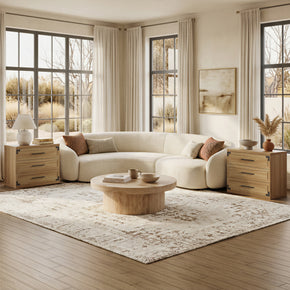
Go round for small nooks, corner spots, and the awkward gap between two armchairs. No sharp corners, nothing to bash your hip on walking past at 2 am. Go rectangular or square for bigger living rooms and sectional sofas where you actually need surface space for the lamp, the book, the drink, the phone, and everything else. If neither shape works for the room, the Sicotas console table collectionoffers narrow options that can serve as a traditional end table.
Get the Scale Right

Scale is the part most amateur stylists get wrong. A chunky console beside a delicate slipper chair just looks weird. A skinny pedestal beside a deep sectional looks as if it got lost on the way to a different room. This is just the broader 2/3 furniture rule applied to side tables — the same proportion guideline covered earlier. As a quick recap: the 2/3 rule says one piece should sit at about two-thirds the size of the piece next to it. For an end table, that means it lands at roughly two-thirds the height of the sofa back, or matches the height of the sofa arm. Heavy dark sofa? Your table can hold more visual weight. Airy light sofa? Keep the table lighter, too. Scale wins more design arguments than style ever has.
36 End Table Decor Ideas to Try Right Now
These 36 end table decor ideas walk through the moves designers actually use on every project—grouped so you can skim to whatever section helps: lighting, layering, books, greenery, trays, texture, and personal pieces. Pick five, try them this weekend, and keep the ones that stick.
Lighting and Anchor Pieces (Ideas 1–5)
1. Start with a lamp.

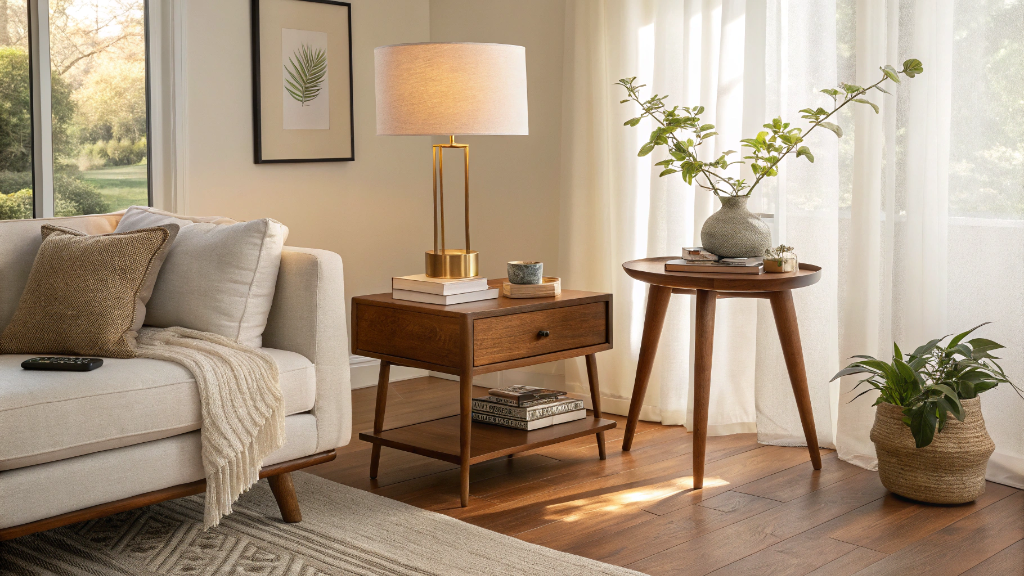
A table lamp is the easiest, most useful anchor for an end table, in terms of vertical height. Warm light. Something to build everything else around. Match the base to the table — chunky lamp on a chunky surface, slim lamp on a narrow one.
2. Skip the lamp if the room is already well-lit.

Swap it for a tall ceramic vase, a sculptural bowl, or an oversized candlestick. You get the same vertical anchor without the bulb. Reads quieter, more like a gallery vignette than a reading corner.
3. Lamp height: 24 to 34 inches.

Measure before you buy. The bottom of the shade should sit just below eye level when you’re seated, so the bulb doesn’t glare at you mid-page. Wrong by a few inches and you’ll feel it every time.
4. Raise a too-short lamp on a riser.

Stack a few hardcover books, or grab a small acrylic block. Either works. Sounds silly. Looks great. Saves you from buying a lamp you don’t actually need.
5. A nightstand makes a great living-room end table.

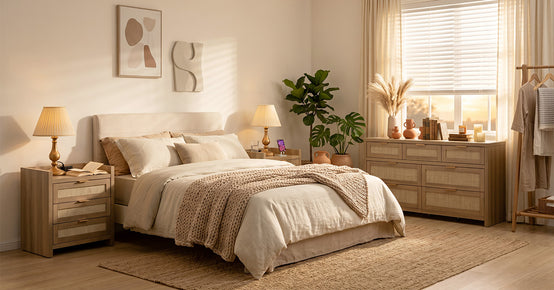
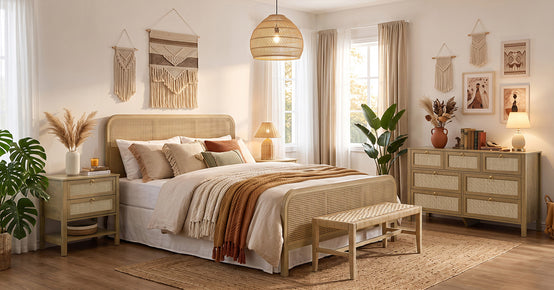
Drawers hide the chaos. A piece like the Savanna Nightstand with 3 Drawers gives you a clean tabletop plus storage for chargers, remotes, batteries, and whatever else accumulates beside a sofa over the course of a year.
Layering and Visual Balance (Ideas 6–10)
6. Three is the magic number.
 Group items in threes, not twos or fours — three reads as "intentional vignette," while pairs feel matchy and quartets start to look cluttered. It's one of those small styling habits that quietly does a lot of the heavy lifting on a finished end table.
Two reads as a couple. Four reads as accidentally even. Your brain knows the difference even when you can’t articulate why.
7. Stagger heights.

Tall lamp, medium vase, low tray. Or tall stems, medium book stack, low candle: same surface, three different heights. The eye reads it as a curated vignette instead of a flat shelf, and decor objects of varying heights are what separate styled from staged.
8. Keep 40% of the surface empty.

Breathing room isn’t a missing ingredient. It’s the thing that makes the rest of the styling look intentional. A small end table that’s completely covered stops being furniture and starts being a still life that’s also blocking your coffee.
9. Edit one piece before calling it done.

Style the table, take a phone photo, then remove the item you like least. Almost every single time, the table looks better with one less thing on it. The discipline to actually do this is the hardest part.
10. Picture a triangle.

Connect your three main pieces with imaginary lines. Balanced triangle = balanced vignette. Skewed triangle = something’s off. Cheapest design trick that consistently works.
Books for Style and Substance (Ideas 11–15)
11. Two or three hardcovers, max.

Books add height, texture, color, and a hint of who you are without taking much real estate. Two or three is the limit. Stack of seven and you’re packing for moving day, not styling for company.
12. Strip the dust jackets.

Designer trick most people skip: hardcover books almost always have beautiful cloth or linen covers under the paper jackets. Pull the jackets off. Instantly more curated. Especially if the jacket colors were fighting the room’s color palette.
13. Use the book stack as a riser.

Stack two books, then set a smaller object on top — a candle, a small ceramic vase, whatever was getting lost on its own. Books give the smaller piece presence and add another layer of texture.
14. Pick books that actually mean something.

Cookbook from your grandmother. Travel book from a trip you actually took. Design book you flip through, not the one with the prettiest cover. Filler books from a thrift store read like filler. People can tell, even when they can’t articulate it.
15. Rotate books between the end table and the shelf.

If you’ve got a tall storage piece like the Willow 75-inch Tall Bookshelf in the room, pull two or three favorites out, put them on the end table for a few weeks, then swap them back. The room stays fresh without you having to buy anything new.
Organic and Natural Touches (Ideas 16–20)
16. Add something alive.

Snake plant. Pothos. Small fern. Anything green softens the hard surfaces of wood, ceramic, and metal, making the table feel lived-in rather than staged. Pick what survives your light situation, not Pinterest’s.
17. Grocery store flowers, simple glass vase.

Truth: a $12 grocery bouquet in a clear glass vase usually looks more designed than expensive florals in a fussy container. Cut the stems short. Group them tightly. That’s it.
18. Dried stems for the no-watering crowd.

Eucalyptus, pampas, bunny tails, dried wheat. All bring softness without the watering reminders. Dust them off every couple of months. They’ll outlast fresh arrangements by a factor of ten.
19. Trailing plants add a sideways dimension.

A pothos or string-of-pearls cascading over the edge of the table breaks up the flat surface and creates movement. Especially good on round end tables where the trailing leaves follow the curve.
20. Swap stems with the seasons.

Cherry blossom branches in spring. Olive branches in summer. Bittersweet in fall. Pine cuttings in winter. Change just the stems and the entire room feels different—no furniture moves required.
Trays, Bowls, and Storage (Ideas 21–25)
21. A tray turns clutter into a vignette.

A small wooden or rattan tray takes the catch-all chaos of small items — remote, coaster, lip balm, whatever you keep dropping there — and turns it into something that looks organized on purpose. The tray is the secret weapon. Cheap, easy, immediate.
22. Woven trays bring instant warmth.

Rattan, jute, seagrass. Natural-fiber trays soften the look of glass or marble tabletops. Especially useful in modern rooms that need texture without a full style overhaul.
23. Small decorative bowl for keys, change, odds.

Beside the lamp. Shallow, simple, ceramic, or wood. Catches whatever you empty from your pockets when you drop onto the sofa. Function first, decor second.
24. The lower shelf is for hidden storage.

A lidded basket on the shelf below holds magazines, throws, kids’ toys, or whatever else you’d rather not see on the tabletop. Keeps the top surface clean. The lower shelf should support the tabletop styling, not compete with it for attention.
25. Marble makes anything look expensive.

Set a candle on a small marble tray. Set a perfume bottle on it. Set your keys on it. Doesn’t matter what — marble does the heavy lifting. Reads as luxe with almost zero effort, which is the best kind of design move.
Texture and Material Mixing (Ideas 26–30)
26. Three materials. Ideally, no more than four.

Wood, ceramic, and glass are the foolproof trio. Add metal for polish. Add rattan for softness. Past four materials, and the table starts to feel like a flea market booth instead of being styled.
27. A candle adds warmth even when unlit.

Ribbed glass. Plain ceramic vessel. A simple tin one. Match it to the rest of the room’s mood rather than whatever happened to be on sale at Target last Tuesday.
28. One metallic accent. Just one.

A brass candleholder. A small gold-rimmed dish. A bronze sculpture. Anything that catches light. Three or more metallic pieces on a small surface, and it starts looking like a department store cosmetics counter.
29. Echo the finish from another piece of furniture.

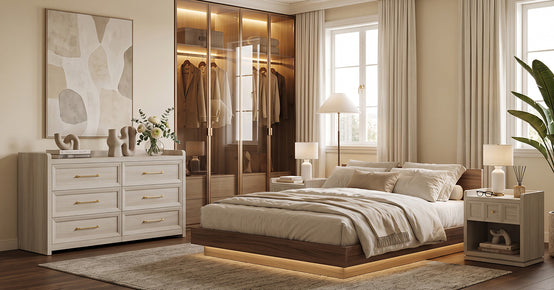
If you’ve got something like the Cas 6-Drawer Dresser elsewhere in the room, repeat that wood tone on the end table. Same finish on at least one element keeps the whole space reading as cohesive rather than accidentally collected. This is the layered textures trick designers use without ever calling it that.
30. Mix smooth and rough.

A high-gloss tray beside a rough wooden bowl. Polished marble base beside a textured woven candle holder. Contrast in texture is what most amateur stylists skip, and it’s the single biggest difference between a table that looks flat and one that looks finished.
Personal Touches and Seasonal Style (Ideas 31–36)
31. One personal item per table.

A framed family photo. A small sculpture from a trip. A handmade bowl your kid brought home from 5th-grade art class. One personal piece does more emotional work than ten generic accessories ever will.
32. Art doesn’t need a frame to count as art.

Carved wooden sphere. Hand-thrown ceramic dish. Folded metal piece. These work like tiny gallery pieces sitting right on the end table. No wall hanging, no nails, no commitment.
33. Try a sculptural sideboard as a feature side table.

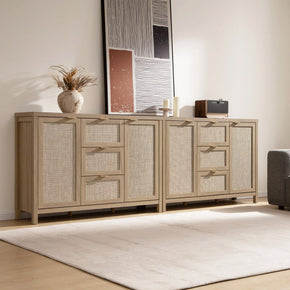
If the room can handle a statement piece, something like the Helio Glass Sideboard with Doors blurs the line between end table and feature furniture, giving you a flexible surface that styles like a small gallery shelf next to the sofa.
34. Light seasonal updates, never full overhauls.

One pumpkin in October. Pinecones in December. Tulips in March. Beach glass in July. One change per season is enough. Light seasonal decor reads more curated than a full theme switch ever does.
35. Match the table to the room’s design language.

Sleek modern lamp on a sleek modern table—vintage brass on warm wood. Matching end tables flanking a sofa read more formal. Mismatched end tables read more collected. Both options work as long as they share a color palette or one repeated material.
36. Style for the life happening around it.

Toddlers in the house? Skip the breakable ceramics. Read in this chair every night? You need a coaster and a working lamp, not a decoration tower. The prettiest end tables also work for the actual humans who live with them. Tabletop decor that ignores how the table gets used is just expensive clutter.
Common End Table Styling Mistakes to Avoid
Five patterns sabotage even nicely chosen pieces. Spot them now, skip the redo later.
Overcrowding the surface. Every inch covered means the table can’t actually function. Aim for two-thirds styled, one-third clear. Minimum.
Everything is at the same height. A row of three medium-height objects looks flat and forgettable. Vary the vertical line. Always.
A lamp scale that fights the table. A tiny lamp on a big table looks like a typo. The oversized lamp on a tiny pedestal looks worse. Match the scale or fix one of them.
No personal items. Showroom-pretty end tables look styled but lifeless. One photo. One keepsake. One thing that’s actually yours — it saves the whole vignette.
Treating it as pure decoration. Can’t set a drink down? You’ve gone too far. Strip a piece. Leave room. The table is furniture first, decor second. Always.
Quick End Table Styling Checklist
Before you call your end table finished, run through this:
- Can you set a drink down without moving something first?
- Is there at least one object taller than the others?
- Is one item personal to you (photo, keepsake, handmade)?
- Is the lamp height between 24 and 34 inches?
- Are at least three different materials present?
- Keep around 40% of the surface clear for a clutter-free table
- Is roughly 40% of the surface still open?
- Have you removed one item to test the look?
If you can answer yes to most of these, you’re done. Stop tweaking.
FAQs
How do you decorate an end table?
Start with one anchor piece — usually a lamp, sometimes a tall sculptural vase — then layer in two or three smaller objects at different heights. A book stack, something organic (a plant, dried stems, fresh flowers), and one item that’s personal to you. Keep at least a third of the surface clear, or the table stops working as a table.
What is the rule of 3 when decorating?
The rule of three says items grouped in threes look more balanced and visually interesting than even-numbered groupings. On an end table, that usually translates to one anchor piece (a lamp), one mid-height object (a vase or book stack), and one low object (a tray or small bowl): three items, three different heights.
What are the 7 essentials of table setting?
Table setting is dining-table terminology — plate, flatware, glassware, napkin, charger or placemat, serving piece, and a centerpiece. For end tables specifically, the seven essentials shift completely: a lamp, a coaster, a tray, a stack of books, something organic, one personal item, and breathing room. Different surface, different rules.
How can I make my table look pretty?
Three moves usually do it. Add a lamp for warmth and height. Mix in two or three objects with different textures — wood, ceramic, fabric, glass. Include something living, like fresh flowers, a small plant, or dried stems. Then remove one piece. The edit at the end is where most amateur styling actually goes wrong.
What is the 3-5-7 rule in interior design?
The 3-5-7 rule is the principle that odd numbers of objects (3, 5, or 7) look more natural and visually pleasing in a grouping than even numbers. The three-piece set is the most common for end tables and small vignettes—five- and seven-piece sets work better for longer surfaces like consoles, mantels, and shelving units.
How to decorate a boring table?
A plain or boring table needs contrast to wake it up. Add height with a sculptural lamp or tall stems. Layer in texture with a woven tray, a ceramic bowl, or cloth-covered books. Include one piece with real character — a vintage object, a piece of art, or something handmade. Texture and personality are what turn a boring table into an interesting one.
What is the 2/3 rule furniture?
The 2/3 rule says that paired furniture should be roughly two-thirds the size of the larger piece. A coffee table should be about two-thirds the length of the sofa it sits in front of. An end table should sit at roughly two-thirds the height of the adjacent sofa back, or align with the sofa arm height. It’s a proportions cheat code that keeps the room visually comfortable.
How to set up an end table?
Place the end table beside your sofa or armchair where it’s easy to reach without leaning — within arm’s length when seated. Match the height to the sofa arm. Then style with a lamp, a tray for everyday objects, a stack of books, and one organic or personal item. Leave a third of the surface open for daily use.
Bring It All Together With the Right Pieces

Good end table decor ideas only work when the table itself is right for the room—proportioned to the sofa and finished to match the rest of the furniture. Sturdy enough to handle the daily wear of drinks, books, remotes, and everything else that ends up there. Browse the Sicotas modern furniture collection for living room pieces that pair well with lamps, books, trays, and the everyday clutter that turns a house into a home worth coming back to.
Sources
- Better Homes & Gardens – End Table Styling Tips
- The Spruce – Decorating a Side Table
- Martha Stewart – Home and Garden Design Inspiration
- Architectural Digest – Interior Design Guides
- House Beautiful – Living Room Decorating Inspiration
- Real Simple – Home Decor and Styling
- Wikipedia – Coffee Table


Looking for something else?

Furniture Materials Guide: Picking the Right Material Room by Room
LEARN MORE
How to Mix Wood Tones Without Making a Room Look Mismatched
LEARN MORE
18 College Apartment Furniture Ideas That Save Space and Money
LEARN MORE
Types of Entertainment Centers: 11 Designs and How to Pick One
LEARN MORELooking for something else?

Curio Cabinet Decor Ideas: How to Style a Display Cabinet Without the Clutter
LEARN MORE
Curved Furniture: How to Style, Measure, and Buy It in 2026
LEARN MORE
What Is Rattan Furniture? A Buyer Guide to Types and Care
LEARN MORE


Further reading

How to Choose a Nightstand for a CPAP Machine

How to Choose a Shoe Cabinet for Men's Sizes, High-Tops, and Bulky Shoes


