















25 Desk Organization Ideas That Actually Work (2026 Guide)

For most of last winter, my desk looked like a crime scene. Three half-finished notebooks. A pile of receipts I'd "get to later." At least four empty coffee mugs. Two chargers tangled with a third charger that didn't work. My stapler had been missing for weeks.
The weird part? I didn't notice that any of it was slowing me down until I cleared it. Then suddenly I could think again.
Turns out there's actual research on this. Princeton neuroscientist Sabine Kastner has spent over 20 years studying attention, and her lab found that visual clutter competes with the brain's ability to focus — tiring out your cognitive function in the background, whether you feel it or not. Your messy desk isn't just ugly. It's eating your bandwidth.
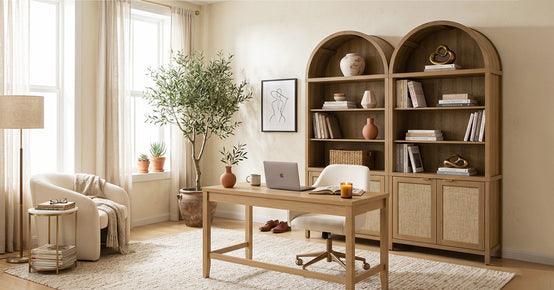
What follows is 25 desk organization ideas that actually work in a real home office — not Pinterest-perfect, just maintainable. If you're also rethinking the furniture around the desk, the home office furniture lineup at Sicotas covers the desks, bookcases, and storage pieces that most of this guide assumes you have in place.
The 25 Ideas at a Glance
Skip around if you want. Each idea is self-contained, and the mistakes most people make with desk organization aren't the big ones — they're the small, repeated ones that pile up. Here's what's covered:
|
Category |
Ideas |
|
Declutter first |
1–3 |
|
Zone your desk |
4–6 |
|
Drawer organization |
7–9 |
|
Cable management |
10–14 |
|
Desktop organizers |
15–17 |
|
Go vertical |
18–20 |
|
Layout & ergonomics |
21–23 |
|
Paper and filing |
24–25 |
|
Bonus |
Daily habits that keep it neat |
Declutter First (Ideas 1–3)
The biggest mistake — I've made it probably six times — is buying organizers before decluttering. You end up organizing clutter. Which means the clutter is still there. It's just more expensive now. Start here instead.
1. Clear the desk completely before you do anything

Everything off the top. Everything out of the drawers. Move it to the kitchen table or the floor — somewhere you can actually see what you've got. This takes about 15 minutes and feels dramatic, but reveals how much stuff was there.
2. Sort into four piles (keep / store/toss / relocate)

Keep: things you use weekly. Store elsewhere: stuff you need but not at the desk (backup notebooks, tax folders you open once a year). Toss: dead pens, expired gift cards, that USB-A cable for a device you don't own anymore. Relocate: things that wandered in from other rooms — there's always at least one mug and one pair of scissors that don't live at a desk.
3. Be ruthless with the keep pile

If you haven't used it in a month, it shouldn't live on the desk. This is the hard part. Do it anyway. A desk with 15 "keep" items will always stay neater than a desk with 40 because there's less surface tension working against you.
Zone Your Desk (Ideas 4–6)
A desk isn't one surface — it's three or four areas doing different jobs. Once you name them, the organization maintains itself.
4. Define a main work zone

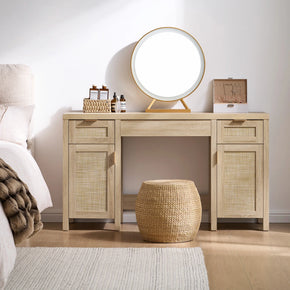
Middle of the desk, directly in front of you. Laptop or keyboard, notebook, whatever you're actively touching. Leave it open. Nothing creeps in here. A desk with enough surface to actually zone — like the Savanna Home Office Desk with 3 Drawers — fixes the root problem for a lot of people whose desks stay messy no matter what they do. A too-small desk is usually the real culprit.
5. Set up a supply zone within arm's reach

One small area off to the side. Pens, sticky notes, a charger or two, the stuff you grab multiple times a day. Keep it contained in one tray or cup, not scattered. Once the supply zone is established, nothing from it drifts into the main work zone.
6. Designate a reference zone further away

Notebooks, folders, reference docs — stuff you need weekly, not hourly. A vertical file holder works here. A small tray in the corner works too. Because it's further from the action, it doesn't interrupt your workflow.
Organize Your Drawers (Ideas 7–9)
7. Use drawer dividers — they're the highest-ROI purchase on this list

Drawers are where organization goes to die. You open the drawer, everything shifts, the stapler slides under the notebook, back to chaos. Drawer dividers solve this for $15–$30. Pens in one section, sticky notes in another, chargers in their own spot, paper clips in a third. Finding things becomes instant. More importantly, putting things away becomes instant too.
8. Separate daily essentials from backup stock

Daily supplies in the top drawer. Backup stock — extra pens, unopened notebooks, the spare pack of sticky notes — somewhere else entirely. A closet shelf works. When your desk drawer becomes a warehouse, it stops being functional.
9. Stop keeping duplicates

You don't need five tape rolls. Ten pens. Three staplers. Pick one of each that works best, move the rest elsewhere, or donate them. Duplicates are a form of clutter that people don't register as clutter.
Fix the Cable Situation (Ideas 10–14)
You can tidy every surface, and if there's a rat's nest of cords underneath, the whole thing still looks chaotic. Cables are the silent killer of a neat workspace.
10. Bundle loose wires

Cable ties, Velcro strips, or adhesive clips that stick under the desk edge — any of these keeps cords from drifting. Bundle by device, not by length. All the laptop-related cables together. All the phone-related ones together.
11. Mount the power strip underneath the desk

This is the move that changed things for me. Stick the power strip to the underside of the desk, or to the back of a leg — out of sight. Suddenly, the whole setup looks twice as clean. Command strips do this for $6.
12. Label every charger

Masking tape on each cable, marker on the tape. "Laptop." "Phone." "Headphones." Saves five minutes of "which one is which" searching. Every. Single. Day.
13. Create one charging zone

If every device has its cord running across the desk to wherever it was last used, you're losing surface to charging alone. Pick one corner. Everything plugs in there. Phones, headphones, the backup battery pack — all of it migrates to one spot when not in use.
14. Toss the cables you don't use

You probably have three USB-A cables for devices that died in 2019. They're not coming back. There's also probably a proprietary charger for a tablet you haven't owned since 2020. It goes too.
Choose Desktop Organizers Carefully (Ideas 15–17)
Here's where people go wrong. They confuse "having organizers" with "being organized." A desk covered in bins, caddies, and decorative boxes isn't organized — it's organized clutter. The point of any organizer is to solve a specific problem. If it's not solving one, it's making things worse.
15. Keep one small tray for active papers

Just one. Not every paper — just the ones currently in play. Empty it weekly. The tray isn't storage; it's a holding area for things that are actively moving through your workflow.
16. One pen cup, not three

A single slim pen cup with the pens you actually use. Three matching themed pen cups are decor, not organization. The same rule applies to scissors, tape, and staplers — one of each.
17. Add a monitor riser (it doubles as storage)

The easiest ergonomic upgrade. Raises your screen to eye level, creating 3–4 inches of storage underneath. Slip a notebook, a small tray, or charging cables under there. Huge surface gain for about $25.
Go Vertical (Ideas 18–20)
If your desk is small, and most are, the answer isn't "get a bigger desk." It's "go up." Vertical storage is the single biggest unlock for a small home office.
18. Install wall shelves above or beside the desk

Two floating shelves 12–18 inches above the desk give you real estate for reference books, a small plant, or a file box — without eating the desktop. Cheap IKEA Lack shelves work fine. So does anything from The Container Store. Use wall anchors rated for 25+ lb.
19. Use the wall behind the desk with a pegboard

A 2×3-foot pegboard ($30–$50) holds scissors, tape, cords, small baskets, and whatever else you want off the desk without being buried in a drawer—hardware-store beige or a painted version — either works. Kaylee Kelly, the professional organizer behind the Core 4 framework, uses this exact setup in small home offices all the time.
20. Add a tall storage piece near the desk

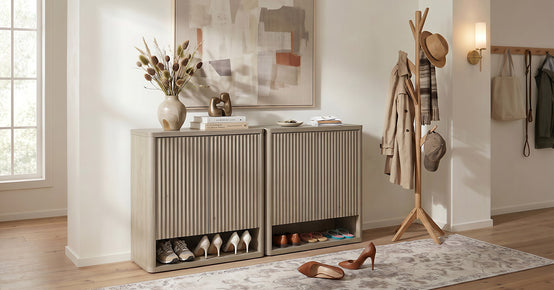
For anything that won't fit on wall shelves or the desktop — binders, extra notebooks, printer paper — a taller enclosed cabinet near the desk handles the overflow. The Stria Storage Cabinet has adjustable interior shelves and a clean, fluted front, which means it hides ugly office stuff without looking like a filing cabinet. One piece like this usually replaces three or four desktop stacks.
Layout, Lighting, and Ergonomics (Ideas 21–23)
Organization isn't just containers. Layout matters too. An awkward desk setup will resist staying neat, no matter how many trays you throw at it.
21. Arrange everything around your dominant hand

If you're right-handed, the pen cup, notebook, phone, and drink all belong on the right side. If you're left-handed, flip it. Sounds obvious, but almost nobody does this on purpose. Reorganize once around your actual hand, and you stop reaching across the desk and knocking over coffee.
22. Add a focused desk lamp

Overhead lighting alone casts shadows on your keyboard and tires your eyes by mid-afternoon. A lamp angled from the side of your non-dominant hand fixes both. Mayo Clinic's office ergonomics guide covers the full setup — monitor at arm's length, top of the screen at or just below eye level, feet flat on the floor. Worth a read even if you think your setup is fine.
23. Protect a clear zone — don't fill every inch

Not every inch of the desk needs a purpose. A clear zone — even just the front eight inches — gives your brain somewhere to land between tasks. If your current desk doesn't even have space for a clear zone, something like the Cas Home Office Desk with its extra-wide desktop gives you enough surface for both zoned work areas and actual breathing room. Tight desks stay messy because everything has to double up.
Manage the Paper Pile (Ideas 24–25)
Paper multiplies. I don't know how. But three notes and a receipt become a stack become a pile become a situation.
24. Enforce a one-tray rule

One paper tray. That's it. Any paper that needs action goes there. Everything else gets filed, scanned, recycled, or shredded — immediately, not later. Nothing lives on the desk "just in case," because "just in case" is how the pile started.
25. Scan everything with your phone

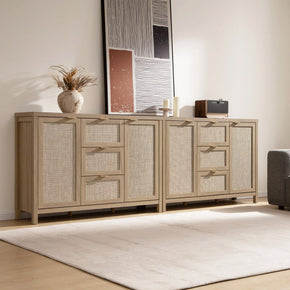
Receipts, handwritten notes, meeting printouts — your phone's scanner app saves them as searchable PDFs in 10 seconds. Once they're digital, recycle the paper. For the few things that truly need physical storage (tax documents, contracts, warranties), keep a small filing drawer elsewhere, not on the desk. A living-room sideboard with interior drawers does this job without the setup looking like an office.
Bonus: Daily Habits That Keep It Neat

A neat desk isn't created once. It's maintained. The people I know with consistently tidy workspaces aren't more disciplined — they just have a few small habits that prevent buildup before it starts.
The 5-minute reset
Last thing before you close the laptop for the day: put items back, toss scraps, wipe the surface if needed. Five minutes. Every day. If you do only one thing from this whole article, do this one.
Weekly supply check
Once a week, open the top drawer. Refill what's low. Pull out what's creeping in that shouldn't be there. 30 seconds.
Monthly reset
Once a month, harder pass. What's on the desk that shouldn't be? What tool have you stopped using? Adjust.
If your whole office (not just the desk) needs help, Apartment Therapy's Core 4 method by professional organizer Kayleen Kelly is the framework I've seen work best. Clear out, categorize, cut out, and contain. The whole process can be done on a desk in under an hour. A whole room takes an afternoon.
Desk Organization Ideas for Specific Spaces

Small home office desk organization
Fewer surfaces means fewer places for things to live — so go vertical and be brutal with the editing. Wall shelves, a monitor stand, a pegboard, and one storage piece outside the desk. Nothing that's "nice to have." Small-space rule: if it's not used weekly, it doesn't live here.
Corner desk organization
Corner desks give you two usable edges, which may seem like more room but can actually create two dead zones at the elbow of the L. Use those dead zones for vertical organizers — a desktop file holder, a small shelf unit, or a plant. Keep the flat edges clear for actual work.
Shared desk organization

If two people use the same desk, zone it vertically instead of horizontally. Each person gets one drawer and one surface section—color-code supplies so you can tell whose pens are whose. A clean-lined desk like the Cas Computer Desk, Fluted Style, works well here because its neutral finish doesn't compete with personal touches on either side.
Student desk organization
Students face the paper problem worse than anyone — binders, handouts, printouts, sticky notes. A vertical file sorter for active classes, a drawer organizer for supplies, and a small bookshelf nearby handle most of it. The 5-minute reset habit is non-negotiable for students. Piles otherwise become unmanageable by week three.
Common Desk Organization Mistakes to Avoid

Buying organizers before decluttering
Already covered — but it bears repeating. You end up storing things you didn't need in the first place.
Using the desk as general storage
The desktop is for the work you're doing now. Not for the mail that arrived last week. Not for the sweater you'll put away later. Not for the Amazon package you haven't opened.
Keeping too many "just in case" items
Extra notebooks. Duplicate tools. A second mouse "in case the first one breaks." They add visual noise for no real payoff.
Over-engineering the system
If your setup requires you to think about it, you won't maintain it. Simple beats clever every time.
Ignoring the stress side of clutter
UCLA's Center on Everyday Lives and Families tracked cortisol levels in 32 families and found real links between cluttered homes and chronic stress. A messy desk isn't just a visual problem — your body registers it as an unfinished task humming in the background, constantly.
FAQs
How do I organize my desk for maximum productivity?
Three moves: declutter first, zone the desk into work/supply/reference areas, and protect a clear zone in front of you. That covers most of the productivity gain. Adding a monitor riser to fix the eye-level issue helps, too.
What are the best desk organization ideas for a small home office?
Go vertical. Monitor riser, wall shelves, tall bookcase, or storage cabinet nearby—drawer dividers. In small spaces, freeing up desktop surface area is the single biggest win you can make — usually more impactful than any product purchase.
How do I organize my desk drawers so they don't get messy again?
Drawer dividers plus strict zoning. Each category has a specific slot. Limit the drawer to daily essentials — backup supplies live in a closet or cabinet elsewhere. If a drawer keeps overflowing, you've got too much stuff, not too little organization.
How can I hide cables on my office desk?
Cable clips, Velcro ties, or an under-desk cable tray. The single biggest move is mounting the power strip under the desk or to a back leg instead of leaving it on the floor. Label each charger with masking tape so you stop hunting for it.
What desk accessories are actually worth buying?
Drawer dividers, a small paper tray, one pen cup, a monitor stand, a desk lamp, and cable management clips. That's basically it. Almost everything else marketed as "desk organization" is decor pretending to be organization.
How often should I declutter my desk?
Quick 5-minute reset daily. Weekly supply check. Monthly deeper pass. That rhythm catches 95% of the buildup before it becomes a project. Seasonal overhaul every 3–6 months if the system has drifted.
What should I keep on top of my desk?
Only what you use multiple times a day. Computer, notebook, pen cup, lamp, maybe a coaster. Everything else goes in drawers or vertical storage. Space is part of the organization, not a gap to fill.
Does desk organization actually improve focus?
Yes, measurably. Princeton research has shown that visual clutter competes with your brain for attention, even when you're not consciously looking at it. Less visual noise means more mental bandwidth for the work itself. The effect is bigger than most people assume.
How do I stop my desk from getting messy again?
The 5-minute end-of-day reset is the single habit that prevents all the buildup of everything else. It takes five minutes. Every day. That's it. People who do this have organized desks. People who don't, don't.
What's the best way to organize cables behind a desk?
Bundle by device (all laptop cables together, all phone cables together), use Velcro ties instead of hard plastic ones so you can adjust later, mount the power strip to the underside of the desk, and add an under-desk cable tray for the slack.
The Bottom Line
A neat desk isn't about buying the right stuff. It's about removing what's in the way and keeping what earns its place.
Start with a clean slate—Zone what's left. Get drawer dividers. Fix the cables. Go vertical with storage. Build the 5-minute end-of-day reset. Those six moves cover about 90% of what a well-organized desk needs, at any budget.
If you're rebuilding the whole workspace — not just tweaking what you've got — shop all home office desks at Sicotas to start with a desk that's actually sized for the way you work. A desk with enough surface area for real zoning, plus integrated drawer storage, solves many "I can't keep my desk organized" problems in one move.
The goal isn't a Pinterest desk. It's a desk that disappears into the background while you do the actual work. Which, if you think about it, is the whole point.
Sources
1. Princeton Alumni Weekly — "Psychology: Your Attention, Please." Research profile on Prof. Sabine Kastner, Princeton Neuroscience Institute. Visual clutter and attention research cited in the introduction.
2. UCLA Newsroom — "The Clutter Culture." Center on Everyday Lives and Families (CELF) four-year study of 32 dual-income households in Los Angeles. Findings on clutter, cortisol, and chronic stress are cited in the Common Mistakes section.
3. Mayo Clinic — "Office Ergonomics: Your How-To Guide." Monitor desk height, chair position, lighting, and posture setup. Cited in the Layout & Lighting section.
4. Mayo Clinic News Network — "Home Office Ergonomics Tips." Remote-workstation setup guidance for workers without a formal office.
5. CDC NIOSH Science Blog — "Working from Home: How to Optimize Your Work Environment and Stay Healthy." NIOSH guidance on break timing, screen breaks, and musculoskeletal health for remote workers.
6. Apartment Therapy — "I Tried the 'Core 4 Method' to Declutter My Home Office." Kayleen Kelly's four-step framework (clear out, categorize, cut out, contain). Cited in the Daily Habits section.


Looking for something else?

Furniture Materials Guide: Picking the Right Material Room by Room
LEARN MORE
How to Mix Wood Tones Without Making a Room Look Mismatched
LEARN MORE
18 College Apartment Furniture Ideas That Save Space and Money
LEARN MORE
Types of Entertainment Centers: 11 Designs and How to Pick One
LEARN MORELooking for something else?

Curio Cabinet Decor Ideas: How to Style a Display Cabinet Without the Clutter
LEARN MORE
Curved Furniture: How to Style, Measure, and Buy It in 2026
LEARN MORE
What Is Rattan Furniture? A Buyer Guide to Types and Care
LEARN MORE


Further reading

How to Choose a Nightstand for a CPAP Machine

How to Choose a Shoe Cabinet for Men's Sizes, High-Tops, and Bulky Shoes


