




16 Corner Makeup Vanity Ideas for a Space-Saving Beauty Corner
Corners get overlooked in bedroom layouts, and a vanity is one of the few pieces that fits one well. It wants a surface, a mirror and a light, and very little floor.
That does not make every corner available. Doors swing into them. Radiators and supply vents sit in them, and blocking either one costs you comfort and sometimes voids a warranty. Closets need clearance in front of the leaf, not just beside it.
Circulation decides it before aesthetics do. Trace the path from the door to the bed and from the bed to the closet. A corner that narrows either route is a corner the vanity should skip, whatever it looks like empty.
Storage competes for the same space in small rooms. A corner that could take a wardrobe or a dresser is doing more work than one holding a vanity, and only you can weigh that against how often you would sit down.
Plan the whole room before placing anything. Tape the vanity footprint on the floor, add the chair pulled out, and walk the room for a few days. Corners that seemed dead often turn out to be carrying something.
Two things decide whether the setup actually works. Lighting that shows your face honestly, and storage that keeps products out of the sun, since heat and light break cosmetics down quicker than people expect.
The 16 corner makeup vanity ideas below suit tiny rentals, shared bedrooms, dressing rooms and closet nooks. Mirror, lighting, seating and storage advice comes after the list.
Plan the Corner Before You Pick a Style
Five minutes of measuring saves a return.
Measure Both Walls, Not Just One
A corner has two dimensions that matter and a diagonal that matters more. Note the baseboard depth too, since it pushes furniture forward by about an inch.
Work Out How Much Storage You Need
Daily makeup is a small pile. Backups, hair tools and skincare are a much bigger one. Count what you own before deciding between two slim drawers and a full cabinet.
Find the Outlet First
Lighted mirrors, hair dryers and straighteners all need power. A vanity placed in the one corner with no socket becomes a very pretty shelf.
Room to Pull the Seat Out
Sliding a stool back and sitting down should not involve hitting the bed. Two separate numbers govern that, and running them together is how vanity corners end up unusable.
Accessible route width is a regulatory minimum. The 2010 ADA Standards set 36 inches as the least clear width an accessible route may have, with a narrow allowance down to 32 inches across a stretch no longer than 24 inches. Those standards govern public and commercial buildings.
Seat clearance is a furniture-planning figure with no standard behind it. The number depends on the depth of the stool, how far it travels to sit down, and the body of the person using it. Nobody publishes a rule because there is no single answer.
Measure your own instead of borrowing one. Set the stool where it lives, push it back to where you actually get up, then measure from the vanity edge to the back of the stool at that position. Add clearance for whoever squeezes past while someone is seated.
Where a wheelchair user needs to reach the vanity, the route to it and the space at it both come under accessibility design rather than styling. That is worth a conversation with an accessible design professional, not a figure from a furniture article.
16 Corner Makeup Vanity Ideas
1. Start With a Compact Corner Vanity

Furniture built for the job is the simplest answer. A three-drawer makeup desk sits into a 90-degree corner with a slim front edge, so it never blocks the walking route past the bed.
Push the deepest storage into the back of the corner. That is the space nothing else can reach.
2. Build an L-Shaped Layout

Two walls give you two work surfaces. Run makeup along one side and storage along the other, and pair awider vanity table with a side cabinet to turn the corner into a proper dressing zone.
Check whether the long section can sit left or right. Reversible layouts move house with you.
3. Float the Vanity on the Wall

A floating makeup vanity keeps the floor visible, which makes a small bedroom breathe. One or two slim drawers hold daily products. The stool slides completely underneath.
Fix it into studs. A vanity carrying a mirror, a lamp, and a hair dryer is heavier than it looks.
4. Choose Hidden Storage Over Open Shelves

Open shelves photograph beautifully and collect dust the rest of the time. A vanity with closed storage puts foundations, palettes, and brushes behind a door, which keeps them out of the light as a bonus.
5. Try a Lift-Top Vanity

On a lift-top vanity, the mirror lives inside the tabletop. Closed, the whole piece reads as a plain desk. Good for studios and shared rooms where the goal isn't to display makeup all day.
6. Go Hollywood With Bulb Lighting

A Hollywood vanity rings the mirror with bulbs, so light hits your face from several directions at once. That is why the look has lasted. Shadows from a single overhead fixture disappear.
Keep the tabletop calm underneath. Let the lights be the drama.
7. Soften the Angle With a Round Mirror

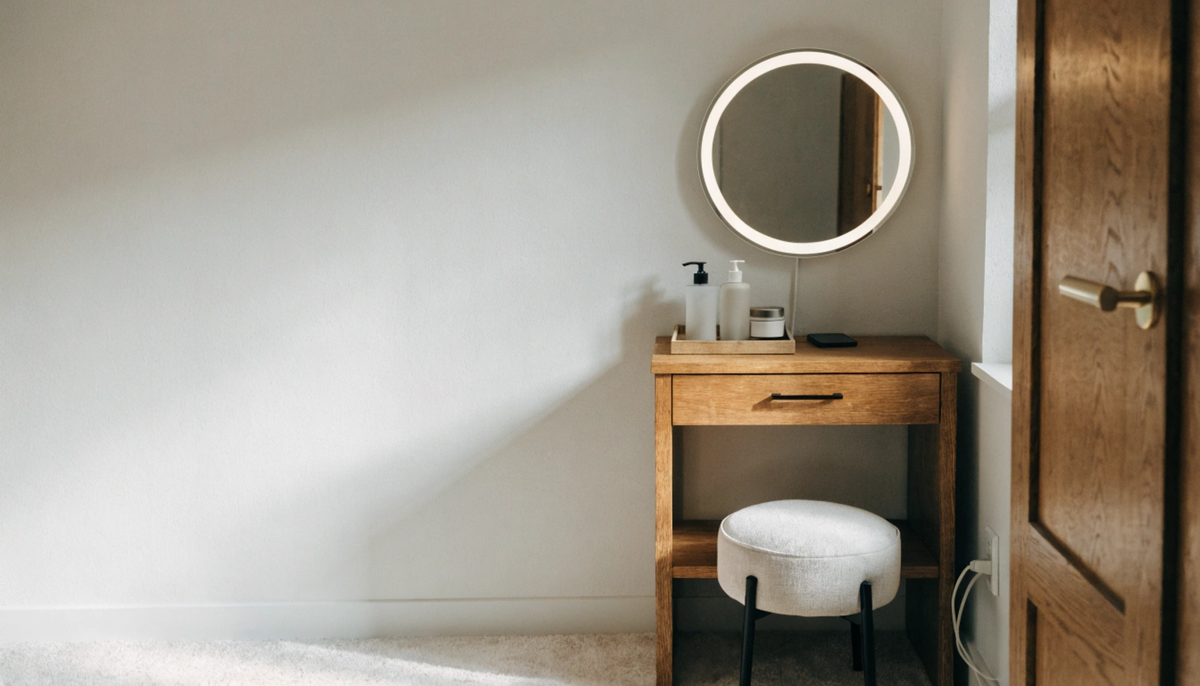
A corner is all hard lines. A round or oval mirror cuts across that and gives the setup a focal point. Hang it centered on where your face lands when seated, not centered on the wall.
8. Use a Tri-Fold Mirror for Side Views

Side panels show your profile, hairline, and the back of a blended jaw. Useful for hair as much as makeup, and it folds flat afterward.
Keep it in proportion. A huge tri-fold on a narrow table looks top-heavy.
9. Put the Vanity Near a Window, With a Caveat

Daylight is the most honest light in the house, so working near a window makes sense. Sit side-on to it instead of facing it; otherwise, you get glare and a shadowed face.
The caveat matters more than the tip. Store products in a drawer, not on a sunlit sill, since sunlight and heat degrade cosmetics and break down their preservatives.
10. Convert a Small Desk

A desk you already own, plus a mirror, makes a vanity. Add drawer trays instead of buying new furniture, and swap the handles if the look bothers you.
Check the height. Desks run higher than most vanity tables, so the stool needs to match.
11. Combine the Vanity and the Nightstand

In a very small bedroom, one piece can do both jobs. Compact bedside tables with two drawers work well, with one drawer for makeup and one for the usual bedside clutter.
Keep the top layer reachable from the bed. Beauty products should not bury the lamp switch.
12. Move Storage Up the Wall

Shelves above the vanity free the tabletop without adding a footprint. Keep everyday products within arm's reach; move backups and decorative pieces higher.
Anchor anything mounted above a seated person. Safety agencies are clear on that, and a shelf over your head is not the place to guess.
13. Keep It Minimalist

Some people want a calm corner, not a display. Leave only what you use daily on the surface and repeat two or three finishes, which is easier when you pull matching bedroom pieces in one finish rather than mixing four different woods.
14. Build a Boho Corner Vanity

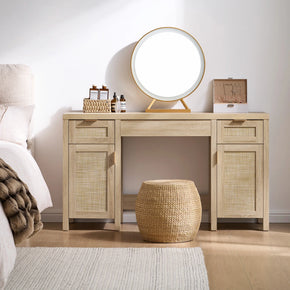
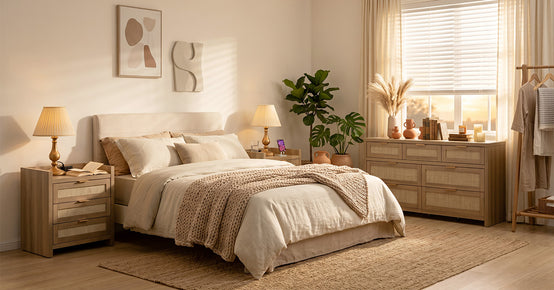
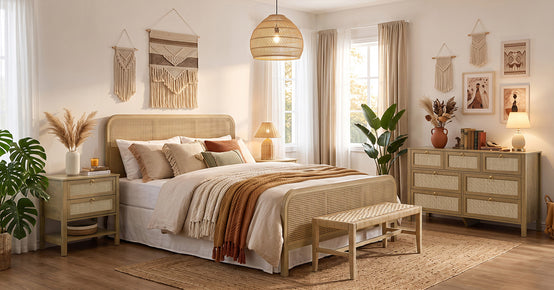
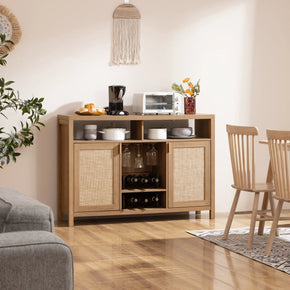
Natural texture warms up a plain corner fast, which is why rattan keeps showing up in boho bedroom vanity ideas. A rattan-front vanity table brings the weave to drawer level, and a woven basket underneath holds hair tools without another cabinet.
Add greenery on a shelf rather than the worktop. Plants and open powder do not mix.
15. Repurpose a Vintage Console

Old writing desks and consoles often have better drawers than new furniture. Change the handles, add a statement mirror, and the piece works as a dressing table nobody else owns.
Test the drawers before buying. Sticky wooden runners will annoy you every morning.
16. Make It a Personal Beauty Corner

Not everyone wants minimal. Wall-mounted brush holders, framed prints, favorite palettes on display and a few collected objects turn the corner into somewhere you enjoy sitting.
The trick is structure. Trays, holders and shelves stop a maximalist corner from tipping into a mess.
Storage Ideas That Keep the Surface Clear

- Drawer dividers, so lip products, compacts and palettes stop sliding into one pile
- Brushes stored upright in a cup or holder, where they can dry properly
- A heat-safe spot for straighteners and curling irons, well away from cosmetics
- Cable clips or a built-in USB port, since trailing cords ruin an otherwise tidy corner
- A shallow tray for the five things you use every morning
How to Choose the Best Mirror for a Corner Vanity
|
Mirror Type |
Best For |
Watch Out For |
|
Round or oval |
Softening a sharp corner |
Limited view of your sides |
|
Rectangular |
Wider tables and structured styles |
Can feel heavy in a tight corner |
|
Tri-fold |
Hair and side-angle checks |
Overwhelming a narrow tabletop |
|
Lighted LED |
Rooms with poor or uneven light |
Low-grade panels with weak color accuracy |
|
Oversized |
Making the room look larger |
Extending past the table width |
Whichever shape you pick, center it at seated eye level. A mirror hung for a standing person is useless once you sit down.
Lighting a Corner Vanity Properly

This is where most vanity guides stop at pretty bulbs. Two numbers on the box matter more than the fixture.
Look for CRI 90 or Higher
Color rendering index tells you how accurately a bulb shows real colors. Department of Energy guidance puts CRI 80 as the interior minimum and rates 90 or above as excellent. Aim for 90+ on a vanity, or your foundation will look different the moment you step outside.
Pick the Right Color Temperature
Warm bulbs sit near 2,700K. Daylight bulbs push toward 5,000K and beyond. Energy Star certified bulbs fall between 2,750K and 6,500K, and around 4,000K suits makeup because it lands between yellow lamplight and blue daylight.
Light the Face, Not the Ceiling
Put light on both sides of the mirror at roughly face height. An overhead fixture on its own drops shadows under the eyes, nose, and chin. That is why makeup done under one so often looks wrong outdoors.
Add Dimming Where You Can
Adjustable brightness covers both a full evening look and a rushed morning face. Fixed lighting only ever gets one of them right.
Choosing the Stool or Chair
Seating decides how much floor the vanity really costs.
Match the Height to the Table
Keep shoulders relaxed and knees clear of the drawers. Vanity tables usually sit lower than desks, so a spare desk chair is often too tall.
Backless Stools Disappear
A stool that slides fully under the table gives you your floor space back when you are not using it. That is the whole argument for a corner vanity in a small room.
Chairs Suit Longer Routines
Doing a full face or blow-drying hair takes a while. A supportive or swivel chair earns its space if you sit there for twenty minutes or more.
Safety and Product Care Most Vanity Guides Skip
Keep Makeup Out of Heat and Light
Sunlight, heat, and air all cut how long cosmetics stay usable. Heat can also break down preservatives, letting bacteria and fungi grow faster. Eye products have the shortest shelf life, and manufacturers usually suggest replacing mascara after two to four months.
A closed drawer beats an open shelf. A sunny windowsill is the worst spot in the room.
Give Hair Tools Their Own Outlet
Straighteners and dryers pull serious wattage.ESFI's extension cord guidance treats a cord as a temporary solution rather than a long-term extension of household wiring, and says not to run one cord for more than one appliance.
That rule concerns the cord, not the wall socket. Counting outlets settles nothing on its own.
Start at the nameplate. Every heat appliance carries a wattage rating, and ESFI says to match the cord's rating to it rather than going lower. Divide watts by 120 for amps. An 1,875 watt dryer draws about 15.6.
Circuit capacity is the next question. That single dryer already exceeds what a 15 amp circuit should carry continuously, before the lights and whatever else sits on the same breaker. A breaker that trips repeatedly is telling you something.
Bathroom receptacles require GFCI protection under the National Electrical Code, with local amendments on top. Look for test and reset buttons on the outlet or upstream at the panel. Missing protection is an electrician's question, not a workaround.
Manufacturer instructions override anything here. ESFI adds that cords must not run through walls, doorways or floors, where trapped heat becomes a fire hazard, and that power strips plug into a mounted receptacle rather than into each other.
Heavy reliance on cords means too few outlets. ESFI's answer is to have more installed rather than to keep adding cords.
Unplug them when you leave the room. Set them on something heat-safe while they cool.
Anchor Tall Units and Shelving
Secure anything tall beside or above a vanity, especially in a home with children who might climb the drawers. Anchoring guidance covers TV stands, bookcases, and chests, and the brackets cost very little.
Keep the Route Clear
A pulled-out stool should not block the path to the door or the wardrobe. Using the 36-inch clear route benchmark as a guide keeps the corner usable rather than obstructive.
Corner Vanity Mistakes to Avoid
- Buying before measuring both walls, the diagonal and the baseboard
- Placing the vanity where a drawer hits the bed frame when opened
- Relying on one ceiling light directly above your head
- Covering the whole tabletop in organizers until there is nowhere to work
- Forgetting the outlet, then running a cord across the walkway
- Choosing a chair too bulky to tuck underneath
- Storing everything on open display in direct sunlight
Final Takeaway
A corner makeup vanity works once four things line up. The piece fits the corner properly. The light shows your face honestly. The storage keeps products out of the sun, and the seat tucks away when you stand up.
Sort those first. Mirror shape, finish and styling are the easy part, and they are the part you can change later.
FAQs
How do you style a corner vanity?
Get the working pieces in first: table, mirror, lighting, storage and seat. Then add a few decorative touches, such as a tray, a perfume grouping, one framed print, or a small plant. Keep enough clear surface actually to do your makeup. That is the bit people forget.
What are the latest trends in makeup vanities?
Integrated LED mirrors with adjustable brightness lead the list, along with built-in USB charging. Hidden and lift-top storage are popular, so are floating wall-mounted designs and round mirrors. Fluted and reeded fronts, warm wood tones, and compact pieces that double as a desk round it out.
What type of mirror looks best on a corner vanity?
A round or oval mirror usually wins, since the curve softens the hard angle of a corner. For makeup itself, a lighted circular mirror is the practical pick, while a tri-fold suits anyone who needs side views. Size it to the table width and hang it at seated eye level.
What are some unique vanity ideas?
Some options worth considering:
- A lift-top vanity that hides the mirror inside the tabletop
- A vanity and nightstand in one compact piece
- A converted vintage console with new hardware
- A reversible L-shaped setup that adapts to either wall
- A floating vanity with the stool tucked fully underneath
How do you choose the right corner vanity?
Measure both walls and the diagonal, then check table depth against your walking route. Work out how much storage you need, find the nearest outlet, plan where the mirror and lighting go, and confirm the stool fits underneath. Style comes after all of that.
How do I make my vanity look cute?
Organize the practical items first, then add a few coordinated pieces: a small vase, a perfume tray, pretty containers, one piece of art, and a decorative stool. Repeating two or three colors or materials makes the whole corner look deliberate rather than randomly collected.
How do I design my vanity?
Design around your actual routine. Decide which products need to stay within reach, how much light you need, and where appliances will plug in. Sort the storage categories next. Finishes, mirror shape, and decorative details are the last decisions, not the first.
How do you style a corner of a room?
Give the corner one clear job instead of filling it with leftovers. A vanity suits it well because it stacks furniture, mirror, lighting, and storage into a small footprint. Keep the scale right for the room and leave enough open floor to move around comfortably.
Sources
- US Food and Drug Administration – Shelf Life and Expiration Dating of Cosmetics
- US Food and Drug Administration – Cosmetics Safety Questions and Answers on Shelf Life
- US Department of Energy – LED Basics, Color Quality and Color Rendering
- US Energy Information Administration – Color Temperature and Color Rendering in LED Bulbs
- US Consumer Product Safety Commission – Anchor It, Furniture Tip-Over Prevention
- Electrical Safety Foundation International – Extension Cord Safety Tips
- Electrical Safety Foundation International – Home Electrical Safety Guidance
- US Department of Justice – 2010 ADA Standards for Accessible Design


Looking for something else?

Burl Wood Furniture: The Complete Buying Guide
LEARN MORE
What Is a Hope Chest? Meaning, History, and Modern Uses
LEARN MORE
What Is a Foyer? Meaning, Purpose and Design Guide
LEARN MORE
GREENGUARD Gold Certified Furniture: What It Really Means for Your Home
LEARN MORELooking for something else?

How to Clean a Mirror Without Streaks: Simple Step-by-Step Guide
LEARN MORE
21 Above-Bed Decor Ideas for a Stylish Bedroom Wall
LEARN MORE
Furniture Materials Guide: Picking the Right Material Room by Room
LEARN MORE


Further reading

18 Decorative Storage Box Ideas That Hide Clutter Well

How to Store Comforters Without Losing Space or Loft


