

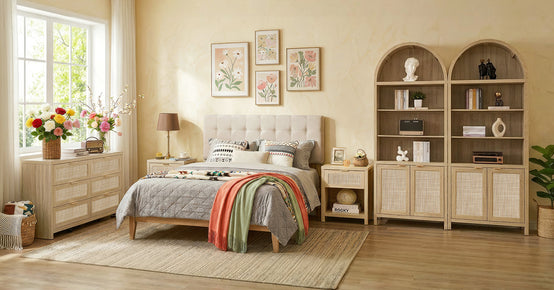
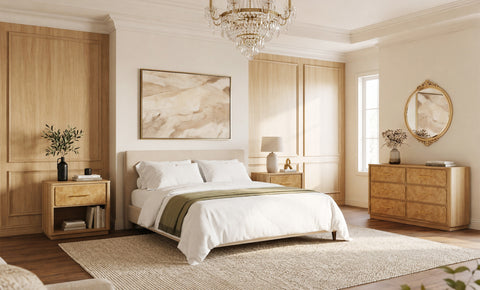








Bedding Layers: The Right Order for a Cozy, Stylish Bed
Look, the bed at that hotel you stayed at last spring is not doing anything mystical. You can absolutely make your own bed look like that. The pieces aren't even particularly expensive at the mid-range. What stops nearly everyone — and I mean nearly everyone, I've been consulting on home interiors for over eleven years, and it's basically universal — is that almost nobody knows what order to put the bedding on, or which pieces they're missing entirely. Most people buy sheets and a comforter and assume that's the assignment.
It isn't. Not close.
A finished bed at a real hotel has somewhere between eight and ten distinct pieces stacked in a deliberate sequence. The average home bed has four or five, usually in some kind of wrong order, with a couple of pretty important ones just... missing. The mattress protector is gone. Someone read a Reddit thread about how Europeans don't use a flat sheet, and now there's no flat sheet. The decorative pillows ended up in front of the sleeping pillows, which means every night they get moved onto a chair, and every morning they get moved back, until eventually the whole decorative pillow situation just sort of fades away. None of these shortcuts seems like a problem on their own. They quietly stack up.
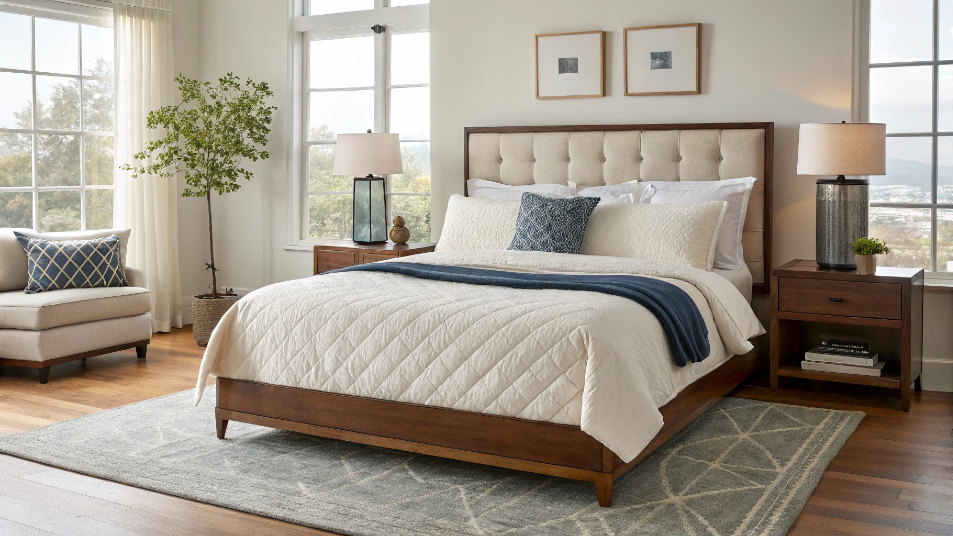
The full 10-step sequence is below, with what each piece is doing, what you can drop in summer or warm climates, and the recurring mistakes I keep running into when people ask me to look at their bedrooms. If you've ever stood at the foot of your bed thinking it looks fine but never quite feels finished, that's almost always a layer problem, not a furniture or fabric problem. Once you actually get bedding layers right, the whole hotel-bed thing stops feeling out of reach.
What "bedding layers" actually means (and why most people get the order wrong)
Bedding layers mean the pieces that stack on a bed in sequence, from the mattress upward. Some of them protect things you can't see, some of them keep you warm, and others are mostly decorative and only there during daylight hours. Each one is doing a specific job. Reverse the order or skip a piece, and you'll feel the difference somewhere — either in the temperature you sleep at, in how often you're hauling sheets to the laundry room, or in how the bed looks at 7 AM when you're trying to take a quick photo of your finished bedroom, and it never reads quite right.
The trap is collapsing layers. Mattress protector gets dropped because someone reasoned they shower at night and won't be sweating much. Flat sheets get dropped because they read somewhere that Europeans don't bother with them. Decorative pillows get shoved in front of the sleeping pillows where they were never supposed to be. Each of these shortcuts feels totally reasonable in the moment. They quietly compound. By month three, you've got a bed you can sleep in, but if a friend stayed over, they'd notice it looked off without being able to say why.
How many layers do you actually need, though? Anywhere from four to ten. It depends on where you live, how hot or cold you sleep, and whether the bed needs to look magazine-ready during the day or just function. Four works fine in a Tucson apartment with a minimalist owner. Ten is what you want in a Vermont winter when guests are coming in two days. Neither is wrong. Pick whichever version actually matches your life, your laundry tolerance, and your patience for restacking pillows night after night.
The 10 Bedding Layers in Order
This is the full sequence. Everything else in this article is built on top of it.
Step 1. Mattress Protector

Goes directly on the mattress and sits there doing invisible work for years. Waterproof or water-resistant is what you want, plus breathable so it doesn't trap heat against your back, plus a tight fit so it doesn't bunch up under the fitted sheet at 3 AM. Most people skip the protector because they can't actually see it on the bed once everything else is on top, which is the same logic as not getting your oil changed because you can't see the engine. Every spill, every drink kicked over on the side table, every bit of sweat from a hot night ends up directly in the mattress without one. You're protecting an item that probably cost a thousand bucks or more; spending $40 to do that isn't a stretch. Replace it every two to three years, sooner if you've got pets sleeping with you.
Step 2. Mattress Topper or Pad

This one's a maybe. Real test: do you wake up sore, or does the mattress feel like a board? If yes, get a topper. If no, don't bother, because you'll add a layer that needs washing, and you're solving a problem you don't have. Wool toppers are the sleeper pick because wool regulates temperature in a way nothing synthetic does — warm in winter, cool in summer, weirdly enough. Memory foam adds plush but traps heat, which most people figure out by month two. Down and down-alternative feel like sleeping on a cloud, but they're not as breathable as wool. A decent topper costs $150 to $400. The $40 ones from Amazon flatten out by month six, and you'll wonder why you bothered.
Step 3. Fitted Sheet

This is the first thing your skin actually touches when you climb into bed, so the fabric you pick here matters a lot more than people give it credit for. Percale cotton is what most decent hotels use. Crisp, slightly cool to the touch, almost like a freshly ironed shirt under you. If a hotel bed has ever felt too smooth or silky, that was probably sateen — same long-staple cotton, woven differently, gives off a slight sheen, sleeps a little warmer, photographs nicely. Linen is the move if you live somewhere genuinely warm or your bedroom doesn't get much airflow; it's a little textured, very breathable, and it actually softens with every wash, which most fabrics don't. Jersey still has buyers who want that lived-in t-shirt feel, though anecdotally I'd guess about 60% of jersey buyers in their twenties switch to percale by the time they hit 35.
Pocket depth is the spec almost everyone misses. Mattresses keep getting taller, what with thicker pillow-tops and the topper trend, and a basic 12-inch pocket sheet just doesn't make the corners on a modern bed. Buy the deepest pocket the brand offers, even if your current mattress is on the thinner side. You'll add a topper at some point, and you don't want to redo your sheet wardrobe twice. The fitted sheet itself should fit tight, almost a little stretched. Loose ones bunch up under you in the middle of the night, and you wake up half-on, half-off the elastic at the corners, which is its own special kind of annoying.
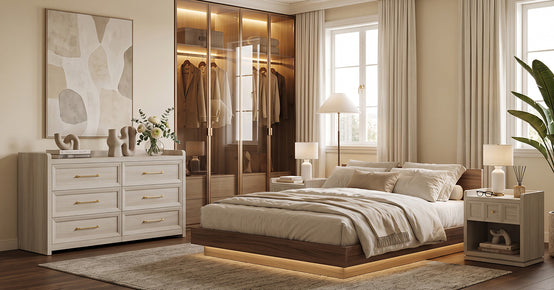
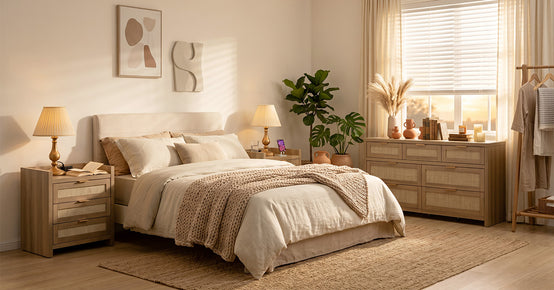
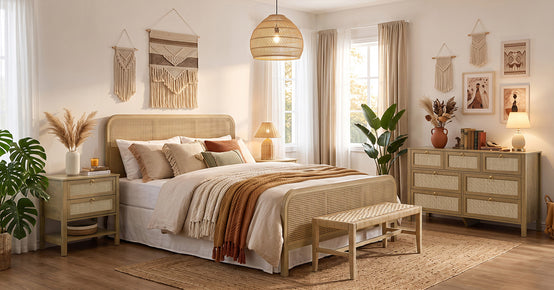
Once you've locked in the sheet color, treat it as the anchor for the rest of the bedroom. The dresser, the nightstand, the rug — they all need to talk back to whatever palette the sheet sets. A Savanna 6 Drawers Dresser in a warm wood finish next to ivory or oat percale, for example, gives the room a clear thread to pull on. Skip that step, and the room ends up looking like a collection of furniture rather than a bedroom that someone designed.
Step 4. Flat Sheet (Optional but Useful)

Easily the most controversial layer in the whole stack. The flat sheet (or top sheet, depending on who you ask) sits between you and the duvet, and the question of whether you actually need one has been a low-key Internet flame war for over a decade now. American beds use one by default, almost reflexively. Most of the rest of the world doesn't bother — sleeping directly under the duvet cover, period. I've slept both ways across maybe a hundred different Airbnbs at this point, and the honest take is there's no objectively right answer. Your preference will sort itself out within about a week of trying the side you don't currently use.
The case for keeping it: your duvet cover stays cleaner longer because the sheet is the thing absorbing skin oil and lotion every night, which means less laundry on the bulky cover. In summer, it doubles as a lightweight cover when the duvet feels like overkill. And it gives you that fold-back move you see in hotel beds, where the top edge of the sheet folds neatly over the duvet for a strip of contrasting color or texture.
The case against it: significantly less laundry overall, less morning bedmaking complexity, and most people who switch to no-flat-sheet say the bed feels noticeably more enveloping at night. Like the duvet hugs you instead of slipping over a slick layer underneath. So skip it for two weeks if you've never tried it, or keep it for two weeks if you have. Whichever feels weird going back to is your answer.
Step 5. Blanket or Coverlet

Middle warmth piece, sitting between the sheet and the duvet. Coverlets are the thin, lightweight option, often woven or matelassé-textured, usually in solid colors. Blankets are bulkier and warmer, your standard wool or cotton throw-style situation. This layer is where the bed starts having visible depth, especially if you fold a textured coverlet back across the bottom third of the mattress; that single move makes a bed look styled without you doing much else. Skip it in real summer, anything above 70°F at night. Add it to the second, the room starts dipping below 65°F. Decent ones cost $150 to $400 from West Elm, Pottery Barn, or Parachute. The $40 versions on Amazon pill noticeably within four months, and you'll regret saving the money.
Step 6. Quilt (or Skip If You Have a Duvet)

Quilts are bigger and louder than coverlets. Visually heavier, often patterned, a real presence in the room. You can use one as your top layer in a warm climate (skip the duvet entirely), or stack it under a duvet in winter for genuine cold-weather warmth. Big rule though: never put a quilt and a coverlet on the same bed. Pick one. Two patterned mid-layers fight each other, and the whole thing reads busy. The pattern math is simple. A solid quilt over patterned sheets works. A patterned quilt over solid sheets works. Pattern stacked on pattern is where beds turn into the visual equivalent of a flea market table.
Step 7. Duvet or Comforter

This is the layer everyone's eye goes to first. Walk into a bedroom, and your brain registers the duvet within about half a second, before it processes anything else in the room. So getting this one right matters disproportionately.
Quick clarification, since the words get used like they're synonyms when they really aren't. A duvet is a two-piece system: the cover, which is basically a giant pillowcase for a comforter, plus the insert that you stuff inside it. The whole thing zips or buttons closed at one end. A comforter is one finished piece, sewn shut, not designed to come apart. Both look almost identical once they're on the bed; the difference is what happens when it's time to wash them.
The practical case for picking a duvet: the cover comes off and goes in the regular laundry, while the heavy insert stays clean inside it for months. So you wash a normal-sized cover instead of trying to cram an entire comforter into a home machine that won't fit it anyway. The case for a comforter is that you skip the assembly step. And assembly is genuinely a pain. Stuffing a cover over an insert by yourself, getting all four corners aligned through a small opening, is its own little workout. There's a YouTube tutorial called the burrito method that helps a lot. I'd watch it before you buy your first cover; you'll thank me on laundry day.
Styling-wise, the move that makes a layered bed actually look layered is to fold the duvet back about a third of the way down from the top, exposing the sheets and any blanket or quilt you've got underneath it. That single fold is doing maybe 70% of what makes a hotel bed look hotel-y. Skip it, and your bed looks fine but kind of flat — pun half intended.
On insert fill: down feels weightless and warm, but the quality varies wildly, and a cheap down insert is mostly air pockets that compress within a year of use. Down-alternative has caught up enormously over the last five or six years; the premium versions are honestly hard to tell from the real thing anymore, and they're easier to wash and gentler on allergies. If anyone in your house starts sneezing the moment they walk into a hotel room, just go down-alternative and don't look back.
Step 8. Sleeping Pillows

Sleeping pillows are the ones you actually put your head on, distinct from the decorative pile. Match the count to the bed: two for a queen, two or three for a king, that's basically it. Side sleepers want a firmer fill, either down-alternative or memory foam, because they need real support for their neck and shoulders. Back and stomach sleepers want softer pillows with lower fill or actual down. Replace them every two years, and don't try to argue your way out of this. Yellowing and stains aren't just cosmetic problems; they're literally the pillow's inner core breaking down. By year three, you're sleeping on something that's basically stopped doing its job. Half the people I know who complain about waking up with neck pain just need new pillows and don't realize it.
Step 9. Decorative Pillows and Shams

This is purely styling, a separate setup from your sleeping pillows. The order: Euro shams (26" x26") sit at the back against the headboard, giving you visual height; then standard or king shams in front of those; then two or three small accent or lumbar pillows finishing the front row. Hotel formula for a king bed is two Euros, two king shams, and one lumbar pillow. Five visible pillows, that's it. People who walk into furniture stores and add eight more usually end up with a bed they have to disassemble every single night, then reassemble every morning, and within four weeks, they've quietly abandoned the whole project, and the pillows live in a chair across the room. Less and you actually keep up with it. More and you stop within the month. There isn't really an in-between version that holds up over the long term.
Step 10. Throw a blanket at the Foot

Last piece. Draped or folded at the foot of the bed. Folded crisply for a polished look, draped more loosely for casual wear. The texture has to contrast with your duvet for any of this to work: chunky knit pairs with smooth cotton, velvet pairs with linen, and faux fur pairs with flat weave. Match the throw to the duvet, and you've defeated the whole purpose of having a throw. Prices are all over the map, $40 at Target, up to $400 from a real wool mill in New England somewhere. I'd say spend roughly what you'd spend on a piece of wall art for that bedroom, because the throw is doing similar visual work.
How to adjust your bedding layers for sleep style and season
Ten steps are the maximum framework. The actual setup you run depends on your body temperature and the current month.
For hot sleepers

Skip the topper. Skip the quilt. Run percale or linen sheets and a light summer-weight duvet, or just a coverlet if it's actually hot where you live. Hot sleepers tend to overcorrect by piling on more layers, thinking it'll feel cozy enough; the right move is the opposite — fewer layers, breathable fabrics, and pajamas that aren't fleece. Cotton t-shirt and shorts in summer; you'll sleep through the night.
For cold sleepers

Wool topper, flannel or sateen sheets, a heavier blanket under the duvet, an ultra-fill (high-loft) duvet, plus a wool throw at the foot for the truly cold nights. The trick people miss: heavier doesn't always equal warmer if the materials are synthetic. Wool stays warm without trapping moisture against the body, and that's why it consistently outperforms polyester or microfiber blends in real winter conditions. If you've been freezing under three synthetic blankets, the issue isn't the number; it's the fabric content of each one.
For minimalists

Four pieces and you're done: a mattress protector, a fitted sheet, a duvet with a breathable cover, and two sleeping pillows. The European default. Half the laundry, none of the morning re-stacking, and the bed still looks clean if your duvet cover is decent quality. The smart move: take whatever budget you would've spent on three additional layers and put it all into one really good duvet cover instead. Sateen cotton or washed linen, no patterns, in a color that matches your wall paint. Done.
Seasonal switching

Swap the heavy winter duvet insert for a lightweight summer one around mid-May, depending on your climate. Flannel sheets come out in October and go back into storage in April. Throws come off the bed in June, return in September. The piece nobody talks about is where everything goes when it's off the bed. Fold the off-season bedding flat in a wardrobe or dresser drawer with a cedar block or lavender sachet, and the pieces will stay genuinely fresh for the six months they sit unused. For bulky winter duvets, a vacuum-seal bag compresses them down to about a quarter of their normal volume. Serious closet space saver if you're working with limited space.
Common mistakes that quietly ruin a layered bed
There are five recurring mistakes that explain almost every layered bed that doesn't quite land. Once you spot which one is happening, fixing it is usually a one-afternoon project.
Skipping the mattress protector
Replacing a $40 mattress protector once every couple of years is meaningfully cheaper than replacing a $1,500 mattress because you let stains seep in. The arithmetic is obvious, and yet people still skip the protector for reasons I don't really understand. Don't be one of them.
Mixing too many patterns
You've got five surfaces that could carry a pattern: sheets, blanket, duvet cover, shams, throw. Adding visual noise to each one is the fastest way to wreck the whole bed. Pros pick one pattern moment, two at the absolute most, and keep everything else solid in the coordinating palette. Spread pattern across all five layers, and you end up with something that looks like a Mother's Day gift basket.
Overloading with pillows
Six pillows are plenty for any bed. Twelve is openly hostile toward whoever's making the bed in the morning, which, statistically, is the exact same person who decided to use twelve in the first place. The two-Euro-plus-two-shams-plus-one-lumbar formula sounds underwhelming on paper, but it holds up because it's the formula professional hotel housekeepers actually use, and they make a lot of beds.
Ignoring scale and proportion
Queen comforter on a king bed leaves visible dead space at the edges, and your partner pulls the comforter off you every night because there isn't enough fabric to share. The king comforter on a queen bed pools on the floor and looks oversized in photos. Match the size to the mattress: comforter, duvet, blanket, all of it. Most of the slightly off-looking beds you see online are actually just sized wrong; people don't realize that's what they're seeing.
Same bedding year-round
Running the same setup in both July and January means you're uncomfortable for half the year. Climate is part of the math here. Even if the only switch you make is a heavier insert in winter and a lighter one in summer, that single seasonal swap will improve your sleep more than any other bedding decision you make.
Style the bedroom around your bedding, not the other way around
Your bedding sets the color temperature of the entire bedroom. The furniture has to fall in line with it, not the other way around. Four principles handle most of the heavy lifting.
Match the nightstand scale to the bed
Light-toned bedding pairs with light or natural-wood nightstands. Dark bedding pairs with darker nightstands or with intentional contrast finishes. The visual weight matters: a heavy duvet pillowed against a skinny little bedside table looks weirdly disconnected, like the table got dropped in the wrong room by accident. The Helio Nightstands Set, 26 Inch Wide hits proportions that work for queen and king beds without disappearing under a layered comforter or fighting for visual attention.
Pick a charging nightstand if you actually read in bed
Doesn't matter how perfectly the bedding is layered if your phone, lamp, water glass, charging cable, book, and reading glasses are all fighting for one tiny surface. The Savanna Nightstand with Charger kills the cable problem that makes most nightstands look chaotic by morning. Built-in charging, drawer storage for the stuff that shouldn't be on display, and enough surface area for what actually does belong out — lamp, water glass, book. Function quietly supports the layered look. Visible clutter quietly destroys it.
Use the dresser to repeat one note
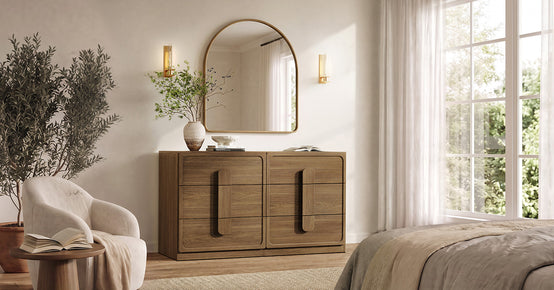
Pull one note from your duvet, usually an undertone or hardware finish, and let the dresser carry that same note across the room. So if your duvet leans warm with bronze accents, your dresser should be in a similar warm tone with similar metal hardware. The Stria Dresser with Large Drawers works well for modern bedrooms because the fluted front and matte finish are flexible enough to bridge warm or cool palettes; it carries a note without dominating it. One repeated detail across the room is enough. Match everything, and you're back to looking like a furniture showroom rather than a real bedroom styled by someone.
Store off-season bedding with intent
Winter duvets, summer linens, and seasonal throws need actual storage somewhere in the room during the months they're not in use. Stuffing them into a hall closet works in theory and falls apart in practice; they get wrinkled, smell musty, and need a wash before going back on the bed. Fold them flat in a tall wardrobe with a cedar block or a lavender sachet, and they stay genuinely fresh throughout the off-season. The armoires and wardrobes collection is built for this kind of storage; interior shelving handles folded linens, the hanging section takes garment bags or quilts on padded hangers, and everything stays accessible without ending up on a closet floor.
Final thoughts: bedding layers should match your life, not someone else's bedroom
Ten layers read as a lot when you write it out, and the truth is that most bedrooms don't actually need all ten. Pick whichever ones match your climate, your patience for laundry, and how much energy you have for restyling the bed every morning. Four well-chosen layers can look just as finished as ten if you've picked the right four pieces.
One principle holds across pretty much every bedroom I've helped style. Bedding is part of the room as a system, not a standalone decision. The duvet has a conversation with the nightstand. The nightstand has a conversation with the dresser. The dresser has a conversation with the wall color and the curtains. Get the layered bed right, and everything else clicks into place behind it. Get the layered bed wrong, and you'll keep rearranging furniture trying to fix something that was never a furniture problem to begin with. The bed is where you start.
FAQs
What are the bedding layers?
Bedding layers are the pieces that stack on a bed, from the mattress upward. The full ten are: mattress protector, mattress topper, fitted sheet, flat sheet, blanket or coverlet, quilt, duvet or comforter, sleeping pillows, decorative pillows, throw blanket. Almost no bed actually uses all ten; the right number depends on your climate, how hot or cold you sleep, and how styled you want the bed to look during the day.
What is the first layer of bedding?
It's the mattress protector. Sits right on top of the mattress and catches everything you'd rather not have soaking into a $1,500 mattress: sweat, spills, dust, dander from pets, and occasional drinks tipped over on the bedside table. Most mattress warranties are voided if the manufacturer can prove the mattress was used without a warranty. Forty bucks to protect a thousand-dollar-plus item is, mathematically, a deal.
What is the correct order to put bedding on?
From the mattress upward: protector first, topper if you're using one, fitted sheet, flat sheet if you keep one, blanket or coverlet, quilt if you keep one, duvet or comforter, sleeping pillows, decorative pillows and shams, then the throw at the foot. The order isn't a stylistic suggestion. Reverse it, and the bed stops working both aesthetically and functionally.
What are examples of bedding?
Sheets (both fitted and flat), pillowcases, duvet covers and their inserts, comforters, quilts, blankets, coverlets, throws, mattress protectors, mattress toppers, pillow shams, and decorative cushions. Older lists also include bed skirts and dust ruffles, though both of those have largely fallen out of fashion in modern bedrooms.
How many types of bedding are there?
There's no fixed number, but bedding splits into four functional categories. Protective: protector and topper. Sleeping: sheets and pillows. Warmth: blankets, quilts, duvets. Decorative: shams, throws, accent cushions. Most well-styled beds end up pulling from all four.
Why is my wife's side of the bed yellow?
Body sweat and skin oils are the main offenders. Skincare products contribute too, especially anything with oils that don't fully absorb before sleep, and hair products are another common culprit. The fix is straightforward: wash sheets weekly, slip pillow protectors under the pillowcases, run a full-coverage mattress protector on the bed itself. For yellowing that's already set in, oxygen-based detergents (OxiClean and similar) outperform chlorine bleach and don't weaken the fabric the way bleach does.
What is the top layer of bedding?
Usually, the throw blanket is folded at the foot of the bed, with decorative pillows arranged in front of the sleeping pillows behind them. On simpler beds, the top layer is the duvet or quilt. The exact answer depends on how layered the bed is — minimalist setups stop at the duvet, while styled setups always finish with a throw. Tying the bed back to coordinated modern Sicotas bedroom furniture grounds the rest of the room around that final top layer.
What are the 4 types of beds?
Most modern lists include platform beds (low-profile, no box spring needed), panel beds (traditional, with both a headboard and a footboard), storage beds (drawers built into the base), and upholstered beds (fabric- or leather-covered frames). Bunk beds, canopy beds, and sleigh beds round out the broader list, but those four cover most modern bedrooms. The bedding layers themselves don't change by frame type — the frame is structural; the bedding is on top.
Sources
- Forbes Vetted — How to Layer Bedding So Your Bed Looks As Good As It Feels
- Real Simple — Bedroom Decorating Ideas We Love
- The Spruce — How to Make a Bed With Multiple Blankets
- Better Homes & Gardens — How to Make a Bed
- House Beautiful — How to Make Your Bed Like a Stylist
- Apartment Therapy — How to Make the Perfect Bed
- HGTV — How to Style a Bed


Looking for something else?

Furniture Materials Guide: Picking the Right Material Room by Room
LEARN MORE
How to Mix Wood Tones Without Making a Room Look Mismatched
LEARN MORE
18 College Apartment Furniture Ideas That Save Space and Money
LEARN MORE
Types of Entertainment Centers: 11 Designs and How to Pick One
LEARN MORELooking for something else?

Curio Cabinet Decor Ideas: How to Style a Display Cabinet Without the Clutter
LEARN MORE
Curved Furniture: How to Style, Measure, and Buy It in 2026
LEARN MORE
What Is Rattan Furniture? A Buyer Guide to Types and Care
LEARN MORE


Further reading

How to Choose a Nightstand for a CPAP Machine

How to Choose a Shoe Cabinet for Men's Sizes, High-Tops, and Bulky Shoes


