

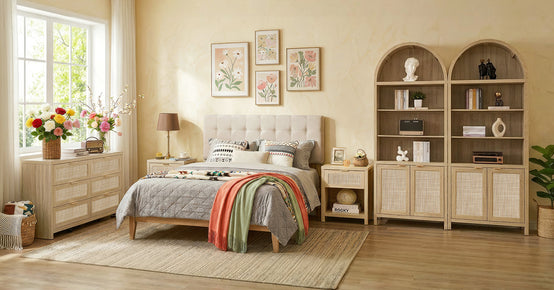
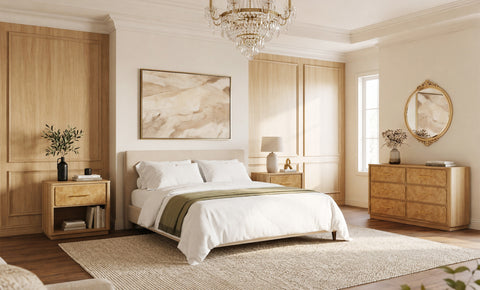














Nightstand Height for a Queen Bed: The Complete Size Guide
Ever notice how the nightstand is always the last decision? The bed gets the budget. The mattress gets the research. By the time anyone thinks about what sits beside it, they're tired of shopping and just want it done. And that rushed pick is the one people quietly regret — a stand too low means groping for your phone on the floor at night, while one too tall leaves the corner looking faintly wrong.
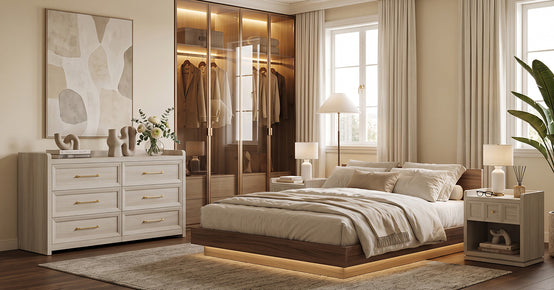
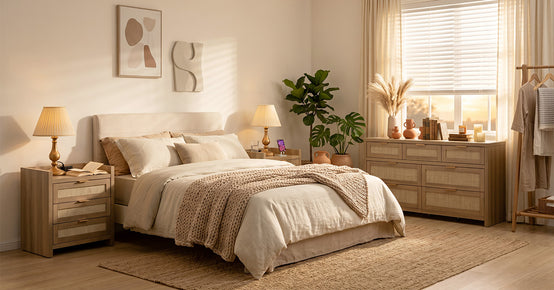
Skip ahead to the answer, then: the right nightstand height for queen bed setups is whatever sits level with the top of your mattress, an inch or two either way. On most queen beds, that works out to 24-28 inches. The word “queen” itself, though, decides almost nothing here. Mattress and frame do. Ahead, you'll find the exact figures, a quick way to measure your own setup, and enough on scale that the piece you choose won't look borrowed from somewhere else. You can see the proportions at work across Sicotas's modern bedroom furniture line, too.
What Is the Ideal Nightstand Height for a Queen Bed?

Level with the top of the mattress, or up to 2-4 inches above it. One rule carries the whole section. Whether the bed is a twin, a full, or a queen changes nothing about it.
That said, most queen beds do land in the 24 to 28 inch zone, and there's no mystery to why. A queen on a standard mattress and frame sits roughly 24 inches off the floor, so a nightstand in that band puts the surface where a half-asleep hand expects it.
The reason “level” matters so much: a nightstand earns its keep by holding the things you reach for without looking. Phone. Lamp switch. A book, a glass of water. When its top matches the mattress top, all of that stays in a lazy arm's reach. When it doesn't, the gap announces itself every night for as long as you own the thing.
On a standard 10- to 12-inch mattress over a low platform frame, a piece like this 25.6-inch nightstand, sized for standard mattress setups, tends to land where it should without any measuring.
Should a Nightstand Be Higher or Lower Than the Bed?

Three positions exist. Only one is the obvious pick, so it's worth knowing them before you spend.
Level with the mattress top—the pick. The surface continues the line of the bed; the look reads as deliberate, and reaching for anything stays easy, whether you're propped up or flat.
Two to four inches higher. Workable, with good reasons behind it now and then — a tall upholstered headboard, under-bed storage drawers, a stand with drawers you'd rather not stoop for. Cross that 4-inch line, though, and the whole thing turns. You start reaching up. The lamp creeps into your view across the bed. The piece begins to outweigh the mattress it's supposed to support.
One to two inches lower.

Acceptable in specific cases, not as a default. Some setups force it: a traditional frame, a box spring, a thick mattress stacked on top, and the bed clears 30 inches with room to spare. Even the tallest nightstand finishes below the mattress top there, and that's fine. What isn't fine is a stand sitting far below the bed, where every reach becomes a stretch you'll come to resent.
Stuck? Match the mattress top. Can't hit it exactly? Lean high before you lean low. And browsing all of it side by side helps — the Sicotas nightstand collection runs from low-profile to tall, so you can shop straight to the height your bed wants.
Standard Nightstand Height Range

Between 22 and 28 inches — that's where industry data places the standard nightstand height, and more than half of every nightstand built falls inside it. Nadine Stay reaches the same numbers in her size guide. The breakdown:
- Low nightstand, under 22 inches. Suit low-profile platform beds, minimalist frames, and beds with no headboard.
- Standard nightstand, 24 to 28 inches. The common range, and the one that an average queen bed wants.
- Tall nightstand, 28 to 32 inches. For box springs, thick mattresses, and oversized headboards.
- Extra-tall nightstand, 32 inches and up. Canopy and panel-bed territory, and not much else.
None of that is a verdict, though. An average reflects what other people bought — it says nothing about your bed. A low-profile platform bed pairs cleanly with something shorter, like this compact single-drawer bedside table, and a taller bed needs the extra inches just to look balanced. Measuring wins over guessing here. It always does.
How to Measure the Right Nightstand Height for Your Bed

Two minutes and a tape measure cover it. The aim is one figure — how far the mattress top sits off the floor — and then a nightstand to match it.
- Measure floor to mattress top. Everything counts: frame, slats or box spring, the mattress, and a topper if you use one. Mattresses run 8 to 16 inches on their own, with a pillow-top or topper adding 2 to 4 more.
- Pick a nightstand near that figure. Level with the mattress top is the aim, or up to 4 inches above it if you like the surface sitting a little proud.
- Run the reach test. From the edge of the bed, stretch toward where the stand will go — your hand should meet the surface with no reaching up, no bending down. Lie back and repeat it. That second check is the one that saves people from a purchase they'd regret.
24 inches: that's a 10-inch platform under a 14-inch mattress, which puts you on a 24- to 28-inch nightstand. Trade up to a thick 16-inch mattress plus a box spring, and you're suddenly past 30. For those, a wide nightstand designed for higher bed frameskeeps the proportions in check. Curious how the mattress layers stack up in the first place? The Sleep Foundation's guide to mattress thickness lays it out plainly.
Best Nightstand Width for a Queen Bed

Height gets the attention. Width is what makes the piece look like it belongs. Sixty inches across is a queen bed, and a small side table next to that just reads as a miss.
A range of roughly 20 to 26 inches wide tends to suit a queen. Enough surface for a lamp, a charger, and a book, without the stand crowding the bed or shrinking against it, which is exactly the slot standard nightstands occupy, and exactly why they pair so easily with queen and full beds.
Call it scale: bigger bed, wider stand. A queen wants something with presence, and a piece like this three-drawer nightstand, sized for a queen-bed footprint, reads as proportional rather than undersized. Going with a pair? Keep the widths equal so the room stays even.
How Your Bed Type Changes the Ideal Nightstand Height

Same bed size, two different rooms, two different nightstands — the frame is what splits them. Here's how the common types compare.
|
Queen bed type |
Typical bed height |
Nightstand height to look for |
|
Low-profile platform bed |
Under 20 in |
20-24 in |
|
Standard platform bed |
20-24 in |
22-26 in |
|
Platform bed with a thick mattress |
24-28 in |
26-28 in |
|
Bed with a box spring and a thick mattress |
30-35 in |
28-32 in |
|
Tall headboard or canopy bed |
Varies (tall) |
28-32 in |
Worth pulling a few things out of that table. Platform beds sit low, so a shorter stand keeps the horizontal line intact rather than breaking it — a low, woven piece like this low-profile rattan bedside table for platform beds moves with the bed rather than against it. Box-spring beds run tall, so taller stands keep the math even. A tall headboard adds vertical weight, which a taller bedside table balances back. None of that is preference. The frame moves the number.
Common Nightstand Height Mistakes to Avoid

The same few slip-ups account for most nightstand regret. Watch for these:
- Buying without measuring the mattress. The classic mistake. A bed-size label says nothing about how high the mattress top actually sits.
- Going too short for a thick mattress. A plush 14 to 16-inch mattress lifts the whole bed, and a 22-inch stand suddenly feels low.
- A 36-inch table beside a standard queen. Too much height, plainly. It looms over the mattress and pulls the corner off-balance.
- Forgetting the lamp. A tall lamp on a tall stand can leave the bulb at eye level. Account for it up front.
- Going too narrow. A 14-inch table next to a 60-inch queen bed simply looks undersized.
- Ignoring drawer clearance. A stand set low beside a tall bed turns its top drawer into an awkward reach.
If you measure first and respect the scale, nearly all of those never come up. And when tangled cables are the real headache, a bedside table with a built-in charging station keeps the cords off the floor while still landing at the right height.
How to Style and Place a Nightstand Beside a Queen Bed

Placement and styling finish what the height started. Leave roughly 3 to 6 inches between the stand and the mattress edge — near enough to reach without leaning, far enough that it isn't fighting the bedding or jamming a drawer. Living Cozy recommends the same gap in its dimensions guide.
Does a queen bed need two nightstands? Not strictly. A matching pair does bring balance and symmetry, which suits couples who each want a surface of their own. One stand still works perfectly well in a small bedroom or a guest room.
Styling tends to come back to a single move: layering. Smaller items toward the front, taller ones like the lamp toward the back, and the lamp shade kept around chin height when you're sitting up, so the bulb doesn't glare. The stand should complement the room rather than match every other piece down to the finish. A three-drawer design like this three-drawer nightstand for couples who want symmetry gives you a coordinated pair plus drawers for whatever you'd rather keep out of sight.
Final Thoughts
Grab a tape measure first. Seriously, before you open a single product page, measure from the floor to the top of your mattress. That number is the whole game.
You'll usually need something between 24 and 28 inches for a queen, but I wouldn't lock that in until you've measured. Mattresses vary more than people realize. A 14-inch hybrid on a low platform is a totally different setup from a pillow-top sitting on a traditional box spring, even though both beds are "queens" on the tag.
Width trips people up, too. Anywhere from 20 to 26 inches works for most rooms. Wider than that, and it starts crowding the headboard. And before you buy, run through the reach in your head. You're half-asleep, lights off, fumbling for the glass of water. If that motion feels weird at the height and width you're considering, something needs to shift.
Nail the three — height, width, reach — and you're done. Skip them, and you'll be the person quietly stacking hardcovers under the legs in six months.
FAQs
How tall should a nightstand be for a queen bed?
Most people end up between 24 and 28 inches, but "queen bed" by itself doesn't decide it. The mattress and frame do. Run the tape from the floor to the very top of your mattress, then pick a stand that lines up with it — or sits up to 4 inches above it if you like the surface slightly raised. Honestly, that's all there is to it.
Should nightstands be higher or lower than the bed?
Even with the top of the mattress, it is the standard answer. Two to four inches taller is fine too, and actually helps if your headboard is tall or your stand has chunky drawers. An inch shorter is okay with a high box spring. The setup you want to avoid? A stand that sits well below the mattress. Reaching down in the dark for your phone every night gets annoying fast — week two, maybe sooner.
Is 32 inches too high for a nightstand?
Depends entirely on your bed. A thick mattress on a box spring can put the sleeping surface around 30 or 32 inches off the floor, and at that point, a 32-inch nightstand looks completely natural beside it. Put that same stand next to a low platform bed, though, and it just towers there. Always measure the bed first. Decide on the second stand.
Is 36 inches too tall for a nightstand?
For a standard queen, yeah, almost always. 36 inches is creeping into dresser-height territory, and it'll sit well above most mattress tops. The setups where it works are pretty specific — tall canopy beds, panel beds running an extra-deep mattress, or older frames with high posts. For a regular queen, stick to 24 to 28 inches, and you won't have to think about it again.
Does a queen bed need two nightstands?
Two looks better in most rooms, no real argument there. It's also just easier for couples — both people get their own surface for a lamp, a charger, whatever book they're three chapters into. But one is genuinely fine in plenty of cases: guest rooms, smaller bedrooms, beds pushed against a wall. Let the room and the people sleeping in it decide. Not some rule on a furniture blog.
What is the rule of thumb for bedside table height?
Match the top of your mattress, or get within a couple of inches. That one tip covers maybe 95% of bedrooms. If you can't hit it exactly, lean a little tall rather than short. A nightstand that sits too low makes you reach down for everything, and that tiny inconvenience adds up every single night you sleep there.
Is 20 inches too short for a nightstand?
For a standard queen bed, it is usually a touch too short. It can suit a low-profile platform bed that sits close to the floor, but next to an average queen, it leaves you reaching down for your phone and water glass. Check your bed's height before lowering it below 22 inches.
How tall is too tall for a bedside table?
Once it climbs more than about 4 to 5 inches above the top of the mattress, or just feels uncomfortable to reach, it's too tall. At that point, you're stretching upward for your things, the lamp can block your view across the bed, and the piece dominates the bed instead of complementing it.
Sources
- Sleep Foundation – How Thick Should a Mattress Be?
- Nadine Stay – The Complete Nightstand Size and Placement Guide
- Living Cozy – Nightstand Dimensions: 5 Tips for Choosing the Right Nightstand
- Birch Lane – Nightstand Dimensions: How to Choose the Right Size
- Nectar – What Is the Perfect Nightstand Height for Your Bedroom?
- Casper – Mattress Thickness Guide: What Thickness Is Right for You?
- Feiges Interiors – 5 Expert Rules for Choosing a Nightstand That Is the Right Size


Looking for something else?

Furniture Materials Guide: Picking the Right Material Room by Room
LEARN MORE
How to Mix Wood Tones Without Making a Room Look Mismatched
LEARN MORE
18 College Apartment Furniture Ideas That Save Space and Money
LEARN MORE
Types of Entertainment Centers: 11 Designs and How to Pick One
LEARN MORELooking for something else?

Curio Cabinet Decor Ideas: How to Style a Display Cabinet Without the Clutter
LEARN MORE
Curved Furniture: How to Style, Measure, and Buy It in 2026
LEARN MORE
What Is Rattan Furniture? A Buyer Guide to Types and Care
LEARN MORE


Further reading

How to Choose a Nightstand for a CPAP Machine

How to Choose a Shoe Cabinet for Men's Sizes, High-Tops, and Bulky Shoes


