

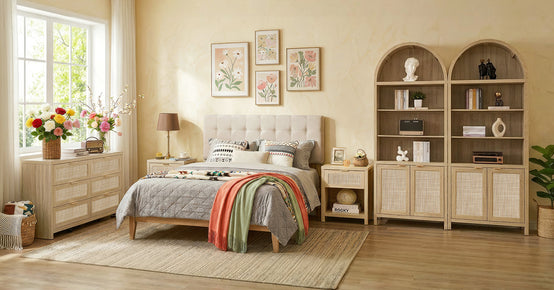
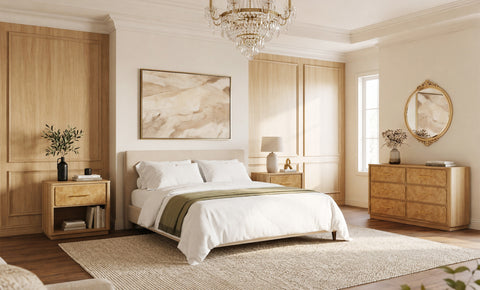
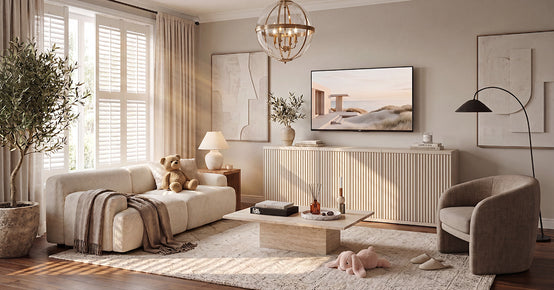
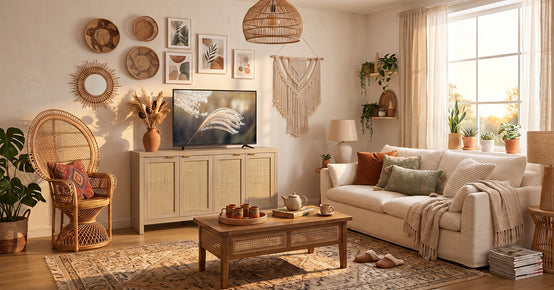



36 Bedroom Ideas for a Calm, Functional, and Stylish Space

Most bedroom problems aren't furniture problems. The paint is usually fine. The dresser is fine. The issue tends to be something smaller — the curtain rod mounted 4 inches above the window instead of near the ceiling, bulbs that are too cool and blue, a bed wedged against the wall on one side because the size was wrong for the room. Cheap fixes with real results.
These 36 ideas cover the full range. Some need five sentences. Some need one. Take what applies to your space.
Still figuring out what the room needs? Browsing the full range ofbedroom furniture first is a reasonable place to start.
1. Sort Out the Bed Placement Before Anything Else
 The bed controls the whole layout — where everything else goes, how the room feels to walk into, whether the space around it is usable or just technically present. In most bedrooms, the right wall is the longest uninterrupted one, usually opposite the door. Put it there, centered, and most other layout decisions sort themselves out. Skip this step, and everything else you buy will compensate for a mistake you made at the beginning.
2. Be Honest About What Bed Size Your Room Actually Fits

A king-size bed in a 10x10 room leaves about 18 inches of clearance on each side. That's not walking space — that's squeezing, twice a day, every day, for however long you live there, which is the kind of small daily friction that compounds into something that genuinely affects how you feel about the room. A queen fits two people, leaves real clearance, and costs less. The extra 16 inches of mattress rarelymake up for what you lose around it.
3. The Headboard Matters More Than Most People Think

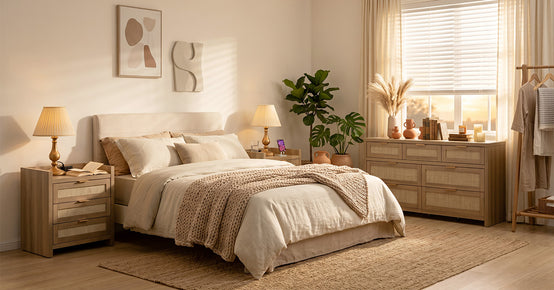
One upholstered headboard — boucle, linen, velvet — changes how the whole bed reads. Heavier. More settled. Done.
The scale matters, too, and this is where it usually goes wrong: a narrow headboard on a wide bed makes it look like something is missing, even in rooms where everything else is right. Size it to roughly match the bed width, and it anchors everything around it.
4. Layer the Bedding Instead of Going All-White

White bedding looks right in photographs. In a bedroom you sleep in, it's flat in a way that's hard to explain but easy to feel. Three tonal shades — cream sheets, a sand duvet, a chunky throw at the foot — look like someone made choices about how the bed should feel, not just picking everything in one color. Nothing needs to match exactly, which is part of why this works better than it sounds like it would.
5. Two or Three Throw Pillows. Not Six.

Two sleeping shams. One lumbar pillow in a different texture. That's a full bed.
Six means removing six things every night and stacking them somewhere. It looks good in a photoshoot and it's a nightly chore in a real bedroom. Cut it down.
6. A Storage Bed Solves More Than a Second Wardrobe Would

Lift-up bases and under-bed drawers are a different thing entirely from plastic bins shoved under an old frame — the storage is accessible, hidden, part of the furniture you're already buying. If your bedroom is short on closet space, which most apartments and older homes are, a storage bed probably handles more of the problem than anything else you could add to the room.
7. Replace the Gray Paint With a Warm Neutral

Gray was the default bedroom color for a decade. In a lot of rooms, it's also why the room feels cold despite decent furniture and what seems like enough lighting — the wall color is undoing everything else is trying to do. Warm beige, sandy off-white, soft clay, taupe. These read warmer in actual light, they sit better next to wood tones, and the shift in how the room feels is more significant than it sounds like it would be before you try it.
8. Dark Colors in a Bedroom Are Underrated

Done right, a dark bedroom can be some of the most restful sleep you'll have.
Navy, deep forest green, warm charcoal, rich burgundy — with light bedding and natural wood alongside them — create a cocooning quality that pale walls can't get to, no matter how good the furniture is. The catch is contrast. One dark wall, with everything else staying soft, is very different from painting every surface dark and then wondering why the room feels heavy.
9. Blue and Green Work Because They Actually Do

No mystery here. Soft blue and sage green show up constantly in bedroom design because they're calm, they pair with almost any wood finish, and they age well in a way that a lot of other color choices don't. Dusty teal, muted olive, slate — none of these will look like a mistake in three years. If you want fresh without trendy, start here.
10. Try Muted Pink Before You Rule It Out

Dusty rose, terracotta blush, and faded mauve are not the same thing as bright pink. If that's your only reference point for the color in a bedroom, the muted versions are worth a sample on the wall before you dismiss the category entirely. With warm wood furniture and linen textures alongside them, they read as genuinely grown-up. Add dark olive or deep brown somewhere in the room, and they stop reading as a kids' space.
11. One Wall.

You don't have to paint all four. A single feature wall behind the bed creates a focal point and some depth without the room feeling like it's closing in. One does the job that four walls overcomplicate.
12. Warm White When Nothing Else Feels Right

The kind with a slight cream or yellow undertone — not the cool blue-white that reads like a hospital ceiling. It works with everything, it doesn't compete with furniture or textiles, and it's the easiest base to build from if you change your mind about color later. Not a boring choice. Often the correct one.
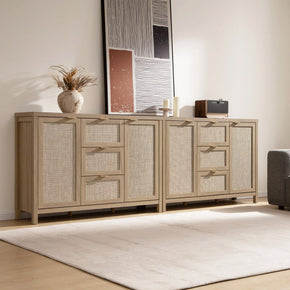
13. A Wide, Low Dresser Gives the Room an Anchor

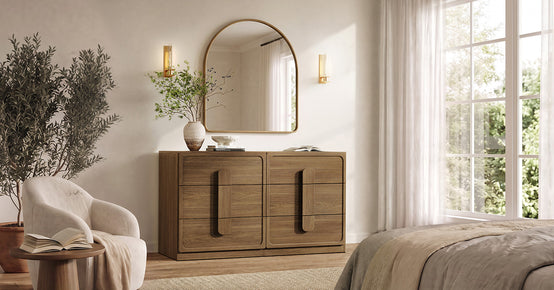
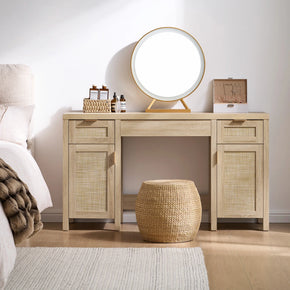
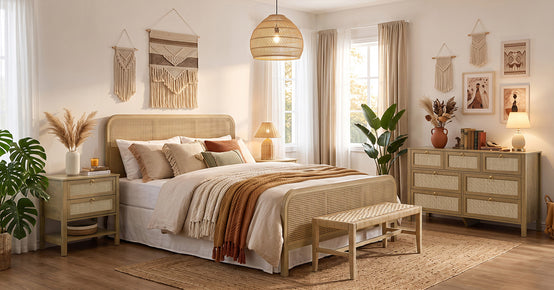
On the wall opposite the bed, a horizontal dresser does two things at once: it holds that wall and creates a natural place for a lamp, a mirror above, and a plant on one side. Storage stops being just storage and starts being part of how the room looks. This is a more useful move than most decorating guides make it out to be, particularly in bedrooms where there isn't much else on that wall.
14. In a Narrow Room, the Dresser Should Go Tall, Not Wide

A tall dresser holds as much as a wide one, sometimes more, while using a fraction of the floor space, which in a narrow bedroom is the actual constraint. The Savanna 6-Drawer Dresser has deep drawers and proportions that don't take over a smaller room. One thing worth checking on any dresser before buying: how the drawers slide. You're opening them twice a day. That detail matters more than the finish, and it's easy to miss in a showroom.
15. Two People Sharing a Room Need More Drawers Than They Think

Six drawers split between two people isn't much. The Savanna 7-Drawer Tall Dresser gives each person a real storage zone without needing two separate pieces of furniture, which is the part that matters, because two dressers in one bedroom are almost always too much. The pile of folded laundry on the chair in the corner of shared bedrooms everywhere: that's a storage problem, not a discipline problem. More drawers fix it.
16. Add a Wardrobe if the Closets Don't Cut It

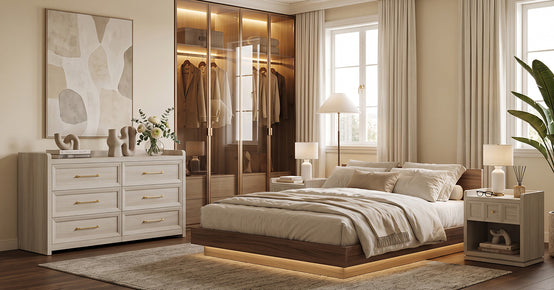
Older homes and most apartments don't have enough built-in closet space. That's a structural reality of the housing stock, not a personal failure. A freestanding wardrobe fills the gap while adding weight and structure to the room. The Savanna Wardrobe 71-inch is tall enough for full-length hanging, with shelf space and drawers below. Looks like it was planned from the start.
17. Floating Shelves Above the Headboard: Keep Them Very Minimal

A plant, two books, a candle. That level of edit. The moment they're loaded up, they stop looking like shelves and start looking like overflow — and the edit is the whole point of them being up there in the first place.
18. The Space Under the Bed Is Real Storage

Most people don't use it. Flat bins or fabric bags hold seasonal clothes, extra bedding, and shoes. Out of sight, accessible. One practical thing: choose a bed frame with legs at least 8 inches high, because anything shorter makes getting things in and out regularly more annoying than it's worth.
19. Nightstand Height Is a Practical Decision, Not a Style One

The surface should sit roughly level with the top of your mattress — not several inches below it, which is where most complaints about nightstands come from. With a standard frame and box spring, the mattress top usually lands between 24 and 30 inches off the floor. Buy in that range. The reaching-in-the-dark problem disappears.
20. Get Drawers on the Nightstand, Not Open Shelves

Open shelves look minimal in a showroom. In a bedroom you live in, everything on them is visible, collects dust, and reads as messy no matter how often you tidy it — because the problem isn't tidiness, it's that there's nowhere for things to go. Drawers solve the actual problem. The Crescent Nightstand has three smooth-glide drawers, which are enough to keep the bedside organized day to day, rather than just after you've cleaned it up.
21. Built-In Charging on a Nightstand Is Worth Having

It sounds minor. It isn't. Hunting for an outlet at 11 pm with a low battery — trying not to wake someone, pulling a cord from across the room, knocking something off the surface — is the kind of small repeated frustration that adds up. The Savanna Nightstand with 3 Drawers has built-in USB and Type-C ports. Cords off the surface. Bedside stays clear. For most people, this matters more than any other single feature on a nightstand.
22. A Bench at the Foot of the Bed

Three uses. Somewhere to sit while putting on shoes. A base that grounds the bed visually. A place for tomorrow's outfit that isn't the floor.
Most bedrooms already have a clothes chair in the corner — a bench at the foot of the bed is the same function, but given a proper place. It's one of those pieces that earns its spot every day.
23. One Large Mirror Opens Up the Room

Across from a window, a large mirror reflects light into the room, making the space feel larger—not as a design theory,but in actual daily experience as you walk in. If a room feels smaller than its square footage suggests, try a mirror before you try anything structural. It's cheaper than repainting and doesn't require choosing colors.
24. Less Furniture Looks Better in a Small Bedroom

Four well-chosen pieces look more deliberate than eight average ones in the same room. That's just how it works. And if you're turning sideways to pass the foot of the bed, something needs to leave — not be rearranged somewhere else in the same space.
25. You Need at Least Three Light Sources in a Bedroom

One ceiling fixture is a light, not a plan. Bedside lamps plus one more source — a floor lamp in a corner, a wall sconce, LED strips behind the headboard — give you the ability actually to change the room's mood. That third source is what makes the difference between a bedroom that's lit and one you want to be in at night.
26. The Bulbs Are Probably Too Cool

Above 4000K feels like a waiting room. 2700K to 3000K is the warm amber range that reads as calm rather than clinical. Most bedroom fixtures come with the wrong default. Swap them — it takes five minutes, costs almost nothing, and the change is obvious the same evening.
27. A Pendant Instead of a Table Lamp Beside the Bed

Hanging pendants free up the entire nightstand surface and have a stronger presence in the room than a lamp base typically does. Worth trying, especially when the nightstand is small and surface space is genuinely scarce.
28. A Dimmer Changes How the Room Functions at Night

One dimmer switch or a smart plug on a bedside lamp. The ability to bring the light down when you're winding down — not just off, but low — changes how you use the bedroom in the evenings in a way that's hard to describe before you try it,but obvious afterward. Small change. Daily return.
29. The Art Above the Bed Needs to Fill the Space

Small art over a wide bed looks like it wandered in from a different room. The rule that holds: cover at least two-thirds of the bed's width with whatever you hang — one large piece, three smaller ones grouped, a textile wall hanging. Any of those works. Going small is the most common mistake here and also the easiest to fix once you know the measurement.
30. One Plant Is All You Need to Start

A trailing pothos on the dresser. A snake plant in the corner. Living texture is something no decor item can replicate, and even a single plant changes the feel of the room in a quiet,subtle way. Start with one. See what it does.
31. Turn the Dead Corner Into Something

Most bedrooms have a corner that's just there. An accent chair, a side table, a lamp — about five square feet. The bedroom gets a second purpose beyond sleeping, and you'll find yourself using that corner more than you'd expect once it has a reason to exist.
32. Mount the Curtain Rod Near the Ceiling

Not at the window frame. Near the ceiling.
Let the curtains fall to the floor. The ceiling reads taller. The room reads larger. It's the most consistently useful curtain trick, and it costs nothing extra — same curtain, same fabric, just hung higher. The version where the rod sits right above the window and the fabric stops six inches short of the floor always looks unfinished, even in rooms with expensive curtains.
33. A Tray Makes the Nightstand Look Considered

Phone, candle, glass of water — together in a small tray, this looks like a decision. The same three things scattered across the surface don't. A tray does a surprising amount for an object that costs almost nothing, and it makes the difference between a nightstand that looks like it was styled and one that looks like things landed there.
34. Add Texture Before You Add Color

Linen, boucle, jute, woven wool — material contrast adds depth without committing to a specific palette, which is why it's a more durable choice than bold accent colors when you're not sure about a direction. A rough throw over smooth cotton. A textured rug under clean furniture. These contrasts are also easier to swap out later if you change your mind, which matters more than it seems up front.
35. Full-Length Curtains Over Blinds, Where You Can

Curtains in linen or cotton soften the room's sound, gradually diffuse light rather than block it outright, and add a sense of movement that blinds can't replicate. If blackout matters — and for most people it does — layer a blackout lining behind sheer panels. Blinds handle light. Curtains handle the atmosphere. In a bedroom, atmosphere is the actual goal.
36. The Last Detail Shouldn't Be Purchased

A book you're reading. A candle in a scent you like. A photo that means something. A ceramic you've moved from place to place for no clear reason.
These aren't accessories — they're what make the room feel occupied by a specific person rather than set up for a photograph. Don't save them for when everything else is done. They're the part that matters most.
FAQs
What are the 2026 bedroom trends?
Warm neutrals — sandy beige, soft clay, taupe — replacing gray as the default. Japandi rooms, which blend Japanese simplicity with Scandinavian warmth, remain popular and probably won't date badly. Statement headboards, layered textures, natural timber, and built-in phone charging are all notable areas. The shift that gets talked about less: full-length curtains coming back as a deliberate design choice rather than just a functional window covering.
How can I make my bedroom look nice?
Five things, most of which don't require buying anything: tonal bedding in two or three shades, a rug that extends past the sides of the bed, two warm bedside lights instead of one overhead fixture, art above the headboard that's the right size for the wall, and surfaces edited down to a tray with two or three items on it. Those five changes make a real difference in almost any bedroom.
What is a 4-piece bedroom set?
Bed frame, dresser, mirror, and one nightstand — though some brands swap the mirror for a second nightstand, so check what's included before buying. The main value is that everything already matches,so you don't have to figure that part out yourself.
What is a 12x12 bedroom?
144 square feet. It's a standard bedroom size and comfortably fits a queen bed, two nightstands, and a dresser, with a planned layout. The most common layout mistake: putting the bed against the shorter wall when the longer wall was the obvious choice.
How big is a 20x20 bedroom?
400 square feet. Bigger than most master bedrooms. Enough for a king bed, a seating area, a dresser, a wardrobe, and a rug — but rooms this size benefit from deliberate zoning. Without it, they feel unfocused rather than spacious, which is the opposite of what you'd expect from the square footage.
What's in a 5-piece bedroom set?
Bed, dresser, mirror, and two nightstands — though some versions swap the mirror for a chest of drawers. Always check the listing since it varies by brand. A 5-piece set is a good starting point for furnishing a main bedroom from scratch because the matching question is already answered.
Can 2 adults and 4 kids live in a 2-bedroom?
Depends on local housing codes, bedroom square footage, and lease terms. HUD has historically referenced a two-person-per-bedroom standard, but it's guidance, not a fixed national law. State and local rules vary considerably. If this is a real situation, check with your local housing authority — the general rule doesn't apply everywhere.
Sources
- House & Garden — Bedroom Ideas and Designs: Gallery of bedroom decorating ideas from interior designers worldwide.
- King Living — 15 Main Bedroom Ideas: 2026's Most Desired Styles: Covers Japandi design, timber surfaces, organic shapes, and bedroom storage.
- House Beautiful — 60 Beautiful Bedrooms With Great Ideas to Steal: Current bedroom color, layout, and decor direction for 2026.
- IKEA — Bedroom Inspiration Gallery: Practical bedroom storage solutions and style ideas for every room size.
- Sleep Foundation — Bedroom Environment for Better Sleep: Research-based guidance on lighting, temperature, and room setup for better rest.
- Houzz — Bedroom Ideas and Designs: Photo gallery with bedroom layout and furniture inspiration.
- Better Homes & Gardens — Bedroom Decorating Ideas: Practical bedroom color, furniture, and small-space guides.


Looking for something else?

Furniture Materials Guide: Picking the Right Material Room by Room
LEARN MORE
How to Mix Wood Tones Without Making a Room Look Mismatched
LEARN MORE
18 College Apartment Furniture Ideas That Save Space and Money
LEARN MORE
Types of Entertainment Centers: 11 Designs and How to Pick One
LEARN MORELooking for something else?

Curio Cabinet Decor Ideas: How to Style a Display Cabinet Without the Clutter
LEARN MORE
Curved Furniture: How to Style, Measure, and Buy It in 2026
LEARN MORE
What Is Rattan Furniture? A Buyer Guide to Types and Care
LEARN MORE


Further reading

How to Choose a Nightstand for a CPAP Machine

How to Choose a Shoe Cabinet for Men's Sizes, High-Tops, and Bulky Shoes


