





30 Minimalist Living Room Ideas That Feel Calm, Not Cold

Okay, story first. My sister moved into her first real apartment a couple of years back and went full minimalist. She bought a white sofa, a blonde wood coffee table, and exactly one plant. She posted a photo. Everyone said it looked amazing. The problem was that nobody actually wanted to hang out there. The room was so calm it felt clinical, kind of like the waiting area of a nice dentist's office.
I went over a few weekends later to help her fix it. We didn't add much—a chunky throw. A proper floor lamp with a real shade on it, not one of those naked Edison bulbs that scream 2016. A rug. That was basically it. Same sofa, same coffee table, same one plant. But suddenly the room felt like somewhere you'd want to spend a Sunday afternoon.
That's the thing nobody really spells out about minimalist living rooms. The good ones aren't empty. They're carefully edited, and there's a big difference. Below are 30 ideas that worked for us, plus a few warnings about what didn't. Skip around as you like. And if you're shopping while you read, the full Sicotas Furniture lineup has a lot of the pieces I'll mention, or pieces close enough to count.
|
3 materials max keeps things cohesive |
30% empty floor the minimalist sweet spot |
1 focal point not three, not five |
2 accent colors pick, commit, stop |
Minimalist Style
Figure out the mood before you buy anything. I cannot stress this enough. I watched my sister buy her sofa first, then try to build a mood around it, and it took us months to undo that one decision. Think about how you want the room to feel. Light and quiet? Warm and grounded? A little moody? Lock that in before the shopping starts.
1. Start with a Neutral Foundation

White, cream, warm grey, soft beige. Yeah, I know, groundbreaking. But these colors are the default for a reason. They bounce light around the room, which genuinely makes small spaces feel bigger. My sister's place faces north and gets almost no sun. We painted one wall a warm greige (that's grey-beige, a real color name nobody loves saying out loud), and the whole room immediately looked about 10 degrees warmer.
2. Try a Bold Dark Palette

Minimalism doesn't have to mean white. Dark chocolate walls, inky navy, near-black charcoal. All can work beautifully. Two conditions, though. First, you need real natural light during the day; the room just reads as a cave. Second, warm wood or brass accents somewhere in the mix. Dark walls with cold metal is how you end up with a vibe that looks more like a venture capital office than a home.
3. Use Color Sparingly and Intentionally

Pick one or two accent shades. Repeat each of them somewhere in the room two or three times. That's the whole rule. An interior designer friend told me he thinks of accent color like salt in a recipe. A little bit, used consistently, makes the room taste like something. Dump the whole shaker in, and you've ruined it.
4. Plan More Storage Than You Think You Need

Storage is the unglamorous foundation of every minimalist room you've ever loved. Every Pinterest-perfect space has a staggering amount of hidden storage you cannot see in the photo. Cabinets. Drawers. Ottomans with lids. Coffee tables with compartments. If you don't plan space for all the small daily stuff (remotes, throws, chargers, the tangle of HDMI cables from whatever device the cable company sent), it ends up on surfaces. And surfaces piled with small items are the enemy of calm. Plan for about 30% more concealed storage than you think you need, and you'll probably still wish you had more six months in.
5. Layer Textures Instead of Colors

Texture is a secret color. Linen reads differently from boucle. Boucle reads differently from smooth oak. Oak is different from rattan. In a beige-on-beige room, five different textures look like five different shades to your eye. Keeps things interesting without any actual color variety.
6. Keep the Living Room for Living

Every extra function the room takes on makes minimalism harder. Gaming setup? Instant cable clutter. Home office? Same. Exercise bike? Let's not. If you can shift those jobs somewhere else, even a small nook in the hallway, the living room gets just to be a living room again. Revolutionary concept, I know.
7. Unite the Room with One Material

Pick one material and beat it like a drum. Warm oak, say. Use it on furniture legs, picture frames, cabinet pulls, and coat hooks. That kind of repetition is what designers call material language, and it's honestly the cheapest trick to make a room look professionally styled. Mix five metals and four woods, and the room won't feel cohesive, no matter how nice each piece is individually.
Minimalist Furniture Styles
Fewer pieces mean each one has to earn its spot. No filler furniture. No, "I guess I'll figure out where this goes eventually." Every item either has a clear reason to be in the room, or it never comes in. Simple rule. Harder to follow than it sounds.
8. Choose a Neutral, Clean-Lined Sofa

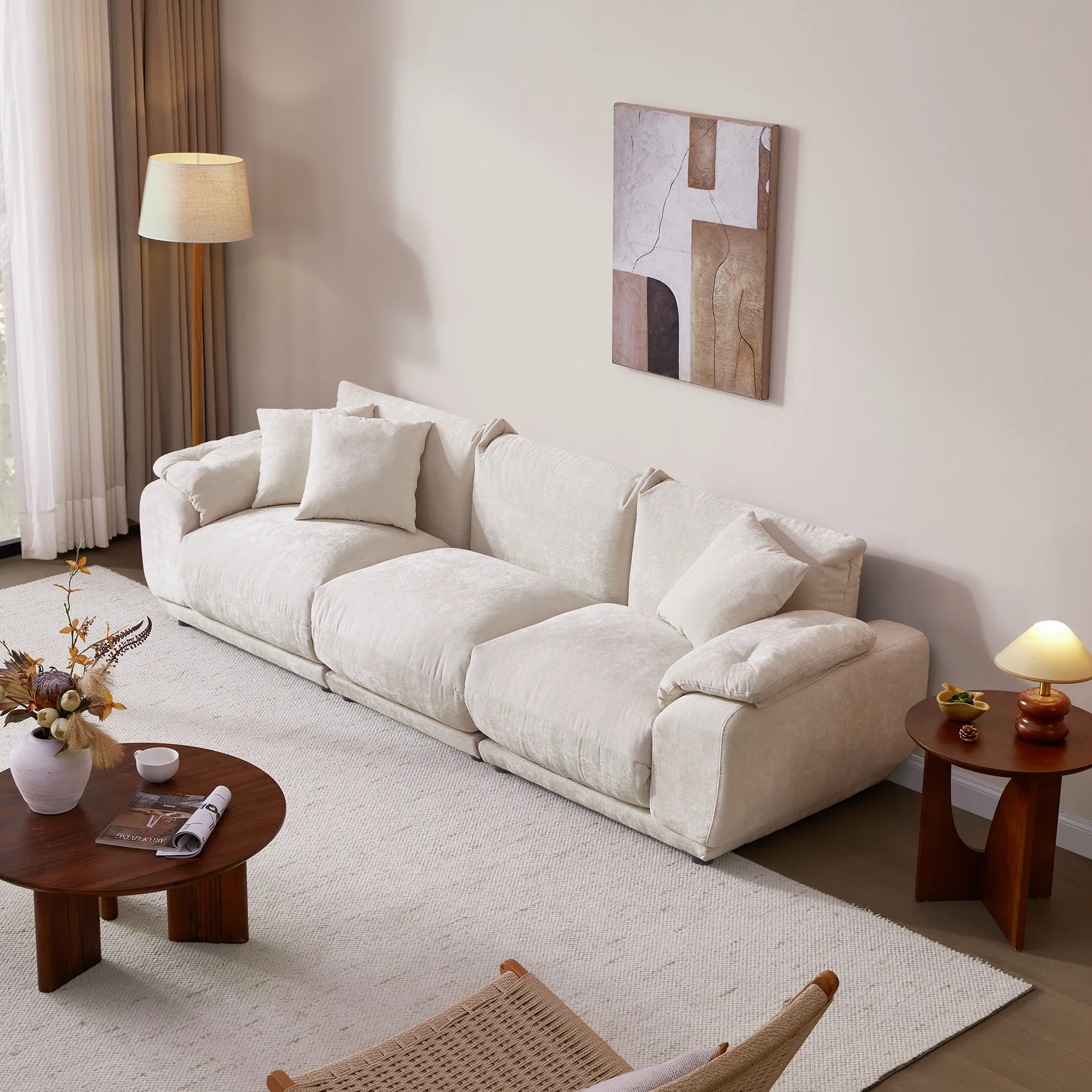
Clean arms. Simple or tapered legs. No skirt around the bottom. That's your checklist. Oatmeal, stone, or warm grey all work as colors. The Nimbus White Sofa Couch fits this brief well. Straight silhouette, cushions with actual depth, nothing fighting for your eye. Drape one textured throw over the arm, and you can honestly stop decorating.
9. Make One Piece the Statement

Or go the other way entirely. One loud sofa in emerald, burgundy, or burnt rust, paired with neutral walls, can actually feel more minimalist than a room full of matching beige pieces. Sounds contradictory. It isn't. The bold sofa becomes the obvious focal point, which means everything else in the room gets to be calm—silence, basically, around one loud thing.
10. Pick Multifunctional Furniture

Any piece doing two jobs is worth paying a little extra for. Storage ottomans. Lift-top coffee tables—sofas with a drawer base. In a minimalist room where every square foot matters, dual-purpose furniture is the cheat code nobody talks about enough.
11. Lead with Storage-Minded Selections

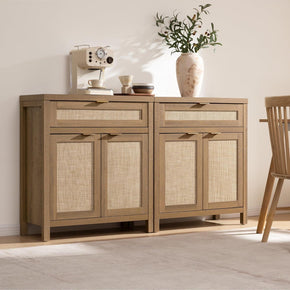
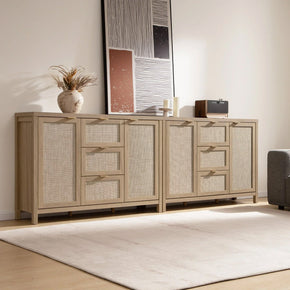
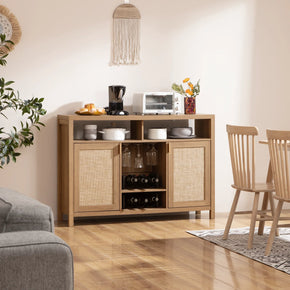
Open shelving photographs beautifully. In real life? Within about two weeks, it fills up with broken-spine paperbacks, half-used candles, and the thing you've been meaning to find a home for since last spring. Closed storage fixes this. A piece like the Stria Sideboard with 2 Doors hides the daily stuff behind flat panels, which means your brain stops registering it. Out of sight, out of brain. That's the bargain minimalism is offering.
12. Show Off Your Empty Space

Show your floor. Seriously. Pick coffee tables, consoles, and sofas that stand on visible legs. The bare floor underneath reads as open space, even though the actual square footage hasn't changed by an inch. Skirted furniture blocks the visual line and makes the whole room feel heavier. Frankly, nobody has been pro-skirt since around 2011.
13. Split the Difference with Half-Storage

Love the look of open legs, but still need places to hide stuff? Go hybrid. A console with closed drawers on top and one exposed shelf underneath. A coffee table with a drawer above and an open space below. You get the airy look and the storage. Best combination if you can't commit to either.
14. Select Hidden Storage Pieces

Storage works harder when it's invisible. A lift-top coffee table. A window bench that opens. A sofa with a pull-out drawer at the base. None of these look like storage at first glance, which is exactly the point.
15. Add a Console Behind the Sofa

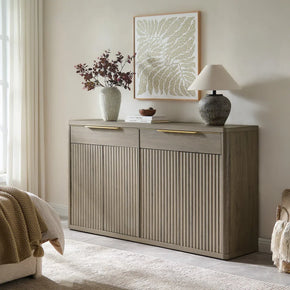
Behind the sofa is dead real estate that most people waste. A slim console back there gives you space for a small lamp, a plant, a framed photo, and maybe a little dish for keys. The Cas Modern Console Table with 3 Drawers is great for this because it's narrow enough not to eat into walkway space, and the three drawers contain small-item clutter before it spills onto your coffee table.
16. Display Books with Intention

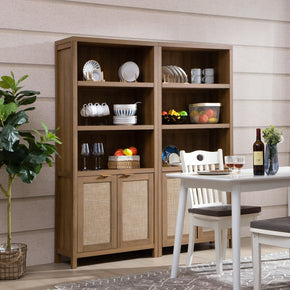
Bookshelves in minimalist rooms get risky fast. They fill up, then they look busy, then the whole calm vibe is gone. Go for one tall, slim shelf and keep it intentionally under-filled. Leave actual gaps between books. Group some horizontally, some vertically. You're curating, not shelving.
17. Choose a Statement Accent Piece

One statement piece per room. Not three. Not two-and-a-half. One. Could be a sculptural armchair, a bold rug, an arched mirror, a funny vintage thing you dragged home from a flea market. Doesn't really matter which. What matters is that everything else takes a step back so the one statement can actually stand out.
18. Add Modern Light Fixtures

Skip the ornate stuff. Minimalist rooms want lighting that's sculptural but quiet. A slim arc floor lamp. A globe pendant. A simple linear chandelier. And since we're on the subject of tech-adjacent furniture, your media zone deserves the same logic. A TV stand with closed panels, like the Helio Modern TV Stand with Doors, hides all the wire spaghetti behind doors. The game console, the soundbar, the streaming box, and the DVD player you haven't used since 2019. All of it vanishes.
Minimalist Decor
With fewer objects, each one matters more. Treat your coffee table the way a gallery treats a wall. Every item on it should feel chosen.
19. Eliminate the Nonessentials

Here's the simplest decluttering test I know. Pick up every object in the room. Ask yourself: Did I consciously choose to put this here? If the answer is "no, it just kind of ended up there," move it or toss it. Real Simple has a longer,clutter-free home guide if you want more structure, but the "did I choose this?" question honestly solves about 80% of it.
20. Find Stylish Hideaways

Baskets. Trays. Lidded boxes. Hugely underrated category of object. They turn a pile of small things into one styled object. I keep a shallow tray on my coffee table with a remote, two coasters, and a small candle. Everything else gets relocated daily. That single tray has prevented an absurd amount of chaos.
21. Don't Shy Away from Color

One big rug in an actual color does more for a neutral room than any decor object will: dusty blue, burnt orange, deep olive. Use color once, loudly, then stop. Works way better than timid color six different times.
22. Go for Colorful Curtains

Curtains are one of the few places where a bold color choice looks intentional rather than random. Blush linen. Soft sage. Dusty mauve. The color filters sunlight during the day, and the curtain mostly recedes at night: low risk, high reward.
23. Pick a Unique Pattern or Texture

Go with a textured rug instead of a strong pattern. Or with a really quiet pattern, like a subtle diamond weave. You get visual depth without introducing a new color conversation. Think of texture as pattern's calmer older sibling.
24. Make Pillows Pop

Two or three pillows on the sofa. Max. Any more and the sofa has officially disappeared. One accent color, one textured neutral. Done.
25. Add an Interesting Throw Blanket

One draped throw over the arm of the sofa. That's the whole tip. It's honestly the cheapest styling move in this entire article, and it makes a sofa look twice as considered as it actually is.
26. Play with Varied Fabrics

Layer different neutral fabrics in the same room. Linen curtains. Boucle chair. Leather pouf. Wool rug. Four different textures, one cohesive palette. The room reads as rich rather than boring, and you haven't used any actual color to pull it off.
27. Add Texture to Neutral Curtains

Don't buy cheap cotton curtains. They always look thin and sad, even when they're technically fine. Spend a bit more on slubbed linen or a textured weave. They hold their shape, catch light properly, and genuinely last longer. Worth it every single time.
Minimalist Finishing Touches
Last few details. These are what separate a room that feels styled from a room that feels lived-in.
28. Bring In One Living Plant

One plant. One big plant. A fiddle-leaf fig, an olive tree, a monstera, or a snake plant if you have a track record of killing things. Green leaves against straight architectural lines are almost physically satisfying to look at. One impressive plant always beats ten scattered small ones.
29. Frame Empty Wall Space

One large art piece at eye level, or three thoughtfully grouped framed prints. Not twelve random frames scattered across a wall. Empty wall space is part of the composition in minimalist design, not a problem to be solved by filling it.
30. Edit One Last Time

Before you call the room done, walk through and remove three things. Any three things. Every minimalist room I've ever finished has three items that could be left the next morning, and nobody would notice. That final edit is really what separates a styled room from a cluttered one. Architectural Digest has a solid write-up on this exact instinct, with minimalist interior design tips worth a read if you're going deeper.
Taking Minimalism Into the Rest of Your Home
Here's something I notice every single time I visit a friend's place. The living room is beautiful. Clearly coordinated, clearly intentional. Then you walk into the bedroom two doors down, and it looks like a totally different person moved in. Different wood. Different vibe. Different everything.
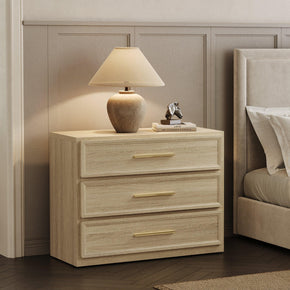
That disconnect isn't a taste problem. It's a shopping problem. The two rooms got furnished at different times, from different stores, with different color stories in someone's head. The fix is simpler than redesigning anything. Shop from one coherent modern furniture collection and let the same material, tone, and design language run through every room you touch. When you see a dresser, a nightstand, and a sideboard all built to feel like siblings rather than strangers at the same party, the choice becomes obvious.
The payoff is subtle, but it's real. Walking from your living room to your bedroom should feel like the same house. When it does, everything looks more expensive, more considered, more grown-up, even if you didn't spend more money to get there.
Minimalist Living Room: Quick Reference
|
Element |
Minimalist Rule |
Good Starter |
Avoid |
|
Color palette |
2 or 3 tones, neutrals dominant |
Cream plus warm oak plus black |
Five clashing accent colors |
|
Furniture |
Clean lines, closed storage |
Sideboard plus console plus one accent |
Overstuffed sofas with skirts |
|
Decor |
One focal point per wall |
One large art print plus one plant |
Shelves full of small trinkets |
|
Storage |
Concealed, not open |
Doors, drawers, lift-tops |
Floor-to-ceiling open shelving |
|
Lighting |
Sleek, sculptural, layered |
Arc lamp plus pendant plus floor lamp |
A single harsh ceiling fixture |
FAQs
How do you start a minimalist living room from scratch?
Remove, don't add. Pull out everything that isn't furniture, then put things back one at a time. Seating first, then rage second. Live in the room for a week or so before you buy any decor. Most people want to finish furnishing fast. Don't. The waiting is kind of the whole point.
What's the biggest mistake people make with minimalist design?
Confusing minimalist with empty. An empty room feels cold and anxious, which is the opposite of what you want. Minimalism needs warmth baked in: texture, a single focal point, soft fabrics. Strip out the excess, not the soul.
How much furniture should a minimalist living room have?
Roughly seating, one or two side surfaces, and one storage piece. That's usually the whole list. If the room feels crowded with two people in it, you've got too much. Open floor space is a feature of this style, not a gap waiting to be filled.
What's the best furniture material for a minimalist living room?
Whichever one you pick and stick with. Oak, walnut, matte,and black metal, brushed brass. All of them work. The rule isn't about the material. It's about consistency. Pick one, repeat it across the furniture, hardware, and accents, and the room will look more designed than places that cost twice as much.
Resources
1. Real Simple Editorial Staff, "Your Guide to Creating a Clutter-Free Home", Real Simple, 2025.
2. Hadley Mendelsohn, "Minimalist Interior Design: Everything You Need to Know", Architectural Digest, July 2024.
3. Erika Owen, "15 Minimalist Living Room Ideas That Don't Feel Cold", Apartment Therapy, March 2025.
4. Homes & Gardens Editorial, "How to Design a Minimalist Living Room — Expert Tips", Homes & Gardens, 2025.
5. Dwell Editorial, "The Principles of Minimalist Interior Design", Dwell Magazine, 2024.


Stay In The Know
Expert advice. Very good deals. The absolute best (and worst) things we've tested lately.
Looking for something else?
How to Arrange Outdoor Furniture for Better Flow and Conversation
LEARN MORE
What Is Faux Leather Made Of? Materials, Types, and Care
LEARN MORE
Can Any Mattress Work With an Adjustable Bed?
LEARN MORE
California King Bed Size: Complete Dimensions, Chart & Buying Guide
LEARN MORERead more from Blogs
Looking for something else?
How to Steam Clean a Couch at Home Without Wrecking It
LEARN MORE
Best Vase for Tulips: A Florist's Honest Guide to Shape, Height, and Styling
LEARN MORE
41 Small Outdoor Living Spaces Ideas to Transform Even the Tiniest Patio
LEARN MORERead more from Blogs
You may also like


Further reading
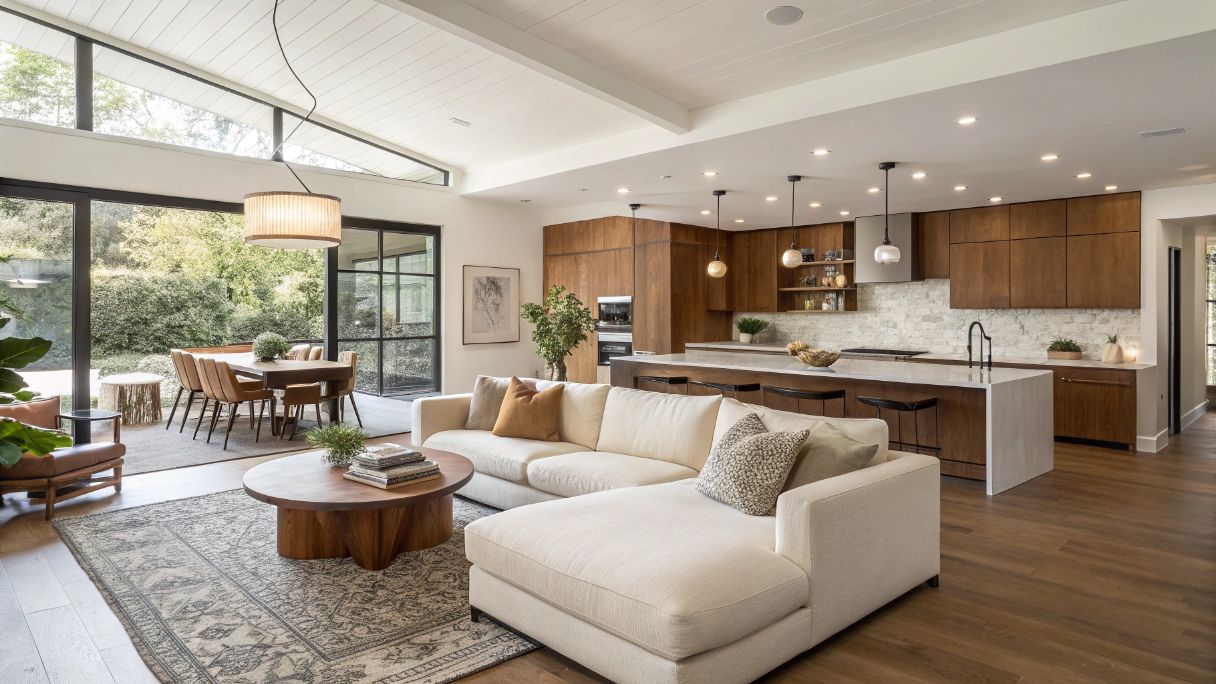
Sectional Sofas for Open Concept Living Rooms: Layout Rules That Work

21 Contemporary Interior Design Ideas to Transform Your Home in 2026


