



Standard Drawer Depth Guide: Sizes, Uses, and Measuring Tips

Nobody warned me about this when I bought my first real dresser. I measured the outside of the piece; it fit the wall. I paid for it, hauled it up two flights, opened the drawers — and my folded jeans were 10 inches thick. The drawer opening was nine and a quarter. That’s the thing that taught me what standard drawer depth actually means, and why the exterior measurement is the one that doesn’t matter.
Drawer depth seems like a simple spec until you actually start looking at numbers. You find a range from 12 to 24 inches and think — okay, that isn’t helpful. But the spread isn’t random; each number covers a different type of furniture. Once you know which category you’re shopping in, the number gets much more specific.
Before getting into specifics, Living Spaces has a solid guide to drawers and drawer measurements worth bookmarking — a good visual reference for measuring correctly when comparing options.
Here’s what this covers: depth numbers by room, a quick sizing table, how to measure correctly, and the most common mistakes that trip people up. One of those — going too deep on everyday drawers — gets its own section. It catches almost everyone.
What Does “Standard Drawer Depth” Actually Mean?

The most common confusion isn’t finding the right depth number — it’s realizing the depth on a product page and the storage depth you actually get are two different figures.
A 24-inch kitchen base cabinet doesn’t fit a 24-inch drawer. It fits a 21-inch drawer. The other three inches disappear into the back panel, the nailer strip, the slide hardware, and the operational clearance the drawer needs to move without binding. None of that space is wasted — it’s all doing something structural. But it means every measurement you read on a product page is the outside of the piece, not the inside of your storage.
That’s why 21-inch slides became the default for 24-inch cabinets. Not an industry quirk — just math, once you account for all the material inside the walls.
Same story with dressers, desk units, closet systems. Listed depth is always the outside measurement, always larger than what you can actually use.
Why the Range Goes from 12 to 24 Inches
When people see that range, they usually figure one end must be wrong. But a nightstand drawer and a kitchen base cabinet drawer serve completely different functions. A nightstand holds a book, a phone charger, some reading glasses — 12 to 14 inches is enough, and anything deeper just means things rolling to the back and vanishing. A kitchen drawer might be storing a Dutch oven or a 12-inch cast-iron skillet. Fourteen inches wouldn’t close.
The depth standards came from the things people actually store in each drawer type. Not design philosophy, not round numbers — just the physical size of the objects.
Quick reference table before the room-by-room breakdown:
|
Furniture Type |
Standard Drawer Depth |
Typical Drawer Height |
|
Kitchen Base Cabinet |
21–24 inches |
4–12 inches (varies by use) |
|
Small Dresser Drawer |
14 inches |
4 inches |
|
Medium Dresser Drawer |
16 inches |
6 inches |
|
Large Dresser Drawer |
18 inches |
8 inches |
|
Reach-In Closet |
14 inches |
5–8 inches |
|
Walk-In / Built-In |
20–24 inches |
5–12 inches |
|
Desk Drawer |
12–18 inches |
3–6 inches |
|
Nightstand Drawer |
12–14 inches |
3.5–5 inches |
Kitchen Drawer Depth

No other room asks as much variety from drawers as a kitchen does. One run of base cabinets might include a silverware drawer, a spice drawer, and a deep drawer for large pots — all of which require different depths. This is where sizing mistakes cost you the most day-to-day.
Base Cabinet Drawers (21–24 Inches)
Kitchen base cabinet drawers run 21 to 24 inches deep. Widths range from 12 to 36 inches — 24 inches being the most common — but depth is what actually determines how useful a kitchen drawer is day-to-day. A wide, shallow drawer is still a shallow drawer. You just have more stuff you can’t reach.
The 21-inch figure isn’t arbitrary — it’s what remains after the back panel, nailer strip, and hardware clearances take their share inside a 24-inch cabinet. Custom work sometimes pushes to 22 or 23 with thinner materials, but most residential kitchens land at 21. Every drawer organizer on the market is sized around it.
Shallow Drawers for Flat, Daily-Use Items

These are your 4- to 6-inch-tall drawers, running about 21 inches deep. Silverware, spatulas, measuring spoons, and a folded dish towel. Flat things you reach for several times a day.
Shallow drawers get called a design compromise. They’re not. A deeper silverware drawer doesn’t hold more silverware — it holds the same silverware in a messier pile. Shallow works for flat, frequently used items because it was designed for exactly that situation. More depth would make them worse, not better.
Deep Drawers for Cookware

Ten to twelve inches tall, running the full 24 inches deep. Pots, Dutch ovens, mixing bowls, bakeware. Pulling a pan straight up from a deep drawer instead of digging it out from the back of a cabinet is one of the better practical upgrades in any kitchen.
One thing that consistently comes up with deep cookware drawers: lids. They slide, won’t stack, and end up on the counter within a week if you haven’t planned for them. Vertical dividers fix this. Much easier to add them during a remodel than to figure it out six months after the kitchen is done.
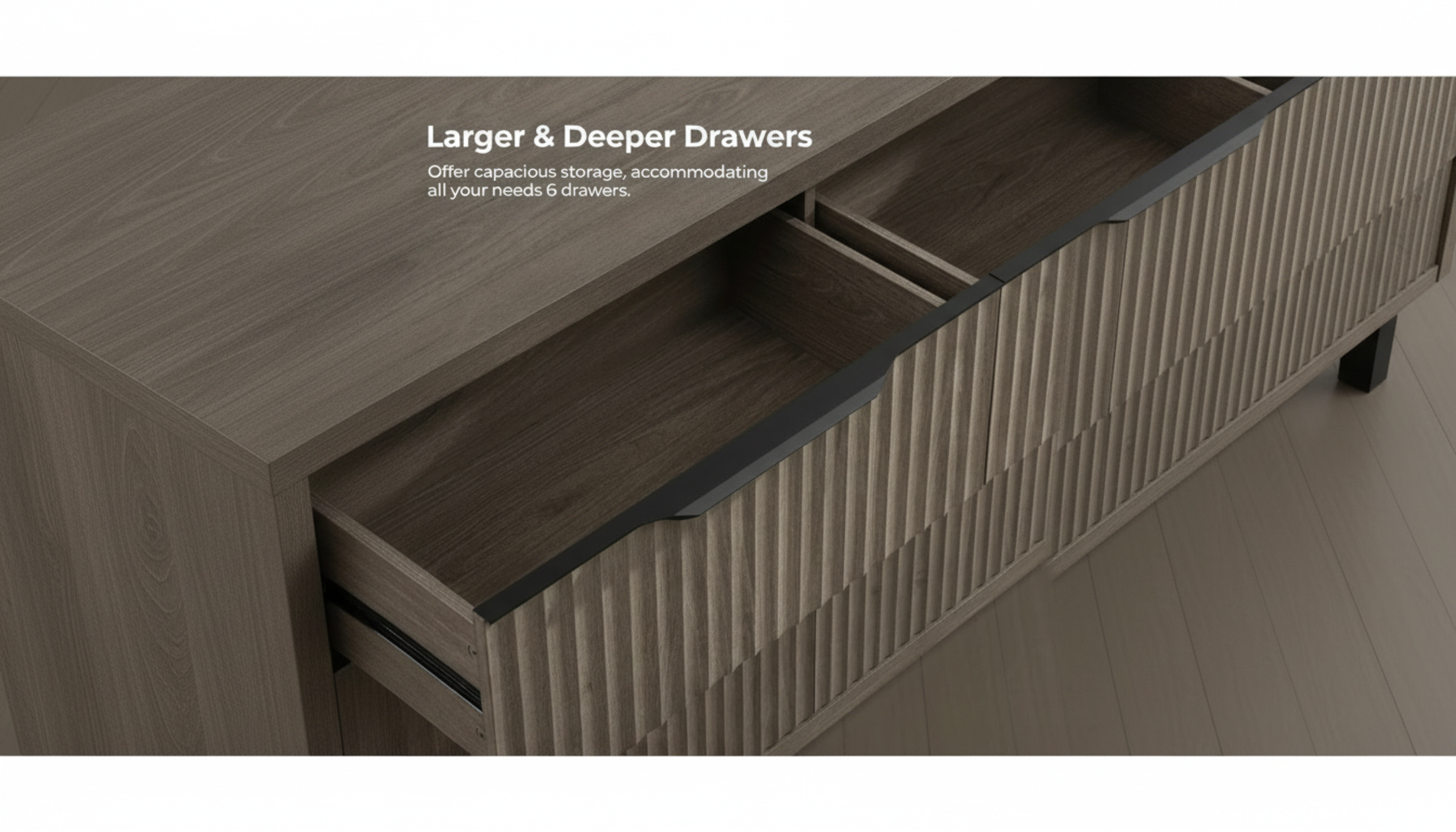
That same principle — right depth for what’s actually going inside — applies directly to bedroom furniture. The Savanna 6-Drawer Dresseris built tostandard dresser depth (approximately 18 inches overall), with smooth metal runners on all six drawers, sized to handle everyday clothing comfortably.
Dresser Drawer Depth

Dresser drawer depths stop seeming random once you know they’re based on actual folded clothing dimensions. A folded t-shirt is roughly 2 inches. Folded jeans are about 3. Small, medium, and large drawer categories each line up with a specific clothing type — the math came from the clothes, not the other way around.
Small Drawers (14 Inches Deep)

Typically 12 inches wide, 4 inches tall, 14 inches deep. Socks, underwear, belts, rolled accessories. The 14-inch depth is just enough for a tidy stack of small items without being so deep that things drift to the back. These drawers aren’t complicated — they do one job well.
Medium Drawers (16 Inches Deep)
About 28 inches wide, 6 inches tall, 16 inches deep. T-shirts, shorts, gym clothes, pajamas — whatever you wear most often. The drawer most people open every single morning. Sixteen inches hits the right balance: deep enough for a real stack of shirts, shallow enough that you can actually see and grab what’s at the bottom.
If I had to pick one measurement to check when comparing dressers, it’s this one. Medium drawers are where most people’s daily wardrobe actually lives.
Large Drawers (18 Inches Deep)

Around 30 inches wide, 8 inches tall, 18 inches deep. Sweaters, heavy jeans, hoodies, thick denim. The 18-inch depth handles bulkier clothing without pushing into territory where smaller items start getting buried (more on that in a minute).
For a tall dresser where the drawer sizes naturally shift — shallower near the top for accessories, deeper toward the base for heavier clothing — the Savanna 7-Drawer Tall Dresser fits a complete bedroom wardrobe in one piece without requiring a second dresser.
Why Going Deeper Than 18 Inches Backfires

More space should mean more storage in kitchen drawers, but logic usually holds. In bedroom dressers, it tends to backfire.
Past 18 inches, everyday items don’t get stored — they get lost. Socks are the obvious example: you rotate the same few pairs from the front while a pile accumulates at the back, untouched. Give it a few weeks, and it’s essentially inevitable. The 14- to 18-inch standard exists to prevent exactly this. Deeper is fine for seasonal items you only pull out a couple of times a year — not for anything you need on a weekday morning.
Desk Drawer Depth

Desk drawers are simpler than kitchen or bedroom drawers—pens, cables, a notebook, a stapler — nothing bulky. Twelve to 18 inches of usable depth covers just about everything a desk drawer holds, and for most home setups, the shallower end of that range is plenty.
A bigger writing desk might go to 16 or 18 inches. A compact home office setup works fine at 12 to 14. On the common question of whether a 20-inch desk is deep enough: for home office and laptop setups, yes. Usable drawer depth in a 20-inch desk usually lands around 12 to 15 inches — more than enough for everyday supplies. Larger workstations with real file storage are a different situation, and those desks (24 to 30 inches) have drawer depths that scale up from there.
Closet Drawer Depth
Reach-In Closets
Reach-in closet drawers are typically 14 inches deep. Most reach-in systems run 20 to 24 inches in total depth, so 14-inch drawers leave the right clearance for hardware and the back panel. That’s enough for a stack of folded shirts or a full layer of accessories, which is really all these drawers need to do.
Walk-In and Built-In Systems

Built-in systems usually go 20 to 22 inches deep. Walk-ins with more room can push to 24, which fits two stacks of clothing front-to-back — a real capacity increase over a reach-in setup.
Widths come in 18, 24, or 30 inches. Twenty-four is the most practical middle option — wide enough for two folded stacks side by side, narrow enough that a drawer full of heavy jeans won’t start sagging at the center after a couple of years.
Drawer heights follow the same logic as dresser drawers: 5 inches for socks and underwear, 8 inches for t-shirts and daily wear, and 10 to 12 inches for heavy knits and denim: same clothing dimensions, same solution — just in a closet system instead of a dresser.

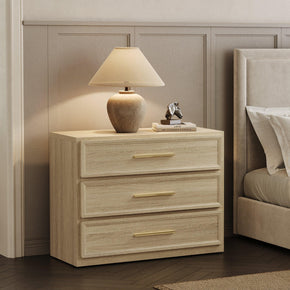
For a six-drawer dresser that handles the full range from socks to thick hoodies without needing a second piece of furniture, the Cas 6-Drawer Dresserfeatures a standard dresser depth across all six drawers and includes smooth metal runners and anti-tip hardware.
Depth, Width, and Height Have to Work Together
Depth gets most of the attention in furniture specs, but a single number doesn’t mean much without the other two. An 18-inch-deep drawer that’s only 4 inches tall and 12 inches wide isn’t useful for clothing, regardless of the depth. All three dimensions need to fit what’s going on at the same time. That’s why standard drawer sizes come in matched sets — change one number without the others, and it stops functioning as intended.
Here’s what catches people off guard: every number on a product page is the exterior measurement. No exceptions. Side-mount slides eat about half an inch per side — a full inch of width before you’ve put a single thing in the drawer. The walls take more. Clearances take more. If you’re buying organizers or figuring out what actually fits, you need to pull out a tape measure and check the interior yourself. The listing won’t tell you.
How to Measure a Drawer the Right Way
The Three Numbers That Actually Matter

Start with an empty drawer. Anything left inside pushes you off the corner,s and you end up with numbers that are off.
Interior width: left wall to right wall, measured at the midpoint of the floor. Not the outside, not the face of the drawer — inside, wall to wall.
Interior depth: inside face of the front panel straight back to the inside face of the back panel. That’s your actual usable storage depth. It will always be smaller than what the listing says.
Interior height: drawer floor to the top edge of the side panel—vertical clearance. Also, on the measurement, most people stop when a thick, folded sweater won’t let the drawer shut all the way.
Those three numbers are what the drawer actually holds. They’ll always be smaller than the product listing. Plan around them — not the specs.
Slide Type Affects Real Usable Space

Two dressers at the same listed depth can have meaningfully different usable storage depending on how the drawers are mounted. Side-mount slides reduce interior width by about half an inch per side. Full-extension slides let you actually use the full drawer depth instead of stopping a few inches short — that matters more than it sounds in deeper drawers, where the back section would otherwise collect forgotten items. Undermount slides don’t cut into width at all and look cleaner, but they mostly show up on better-made pieces. Worth knowing before you buy.
For a modular setup that adjusts to the room rather than making the room work around fixed furniture dimensions, the Zura Modular 9-Drawer Dresser uses a stackable design with nine drawers in total — offering more configuration flexibility than a standard fixed piece, without the cost of custom cabinetry.
Sizing Mistakes Worth Knowing Before You Buy

Making Everyday Drawers Too Deep
In a dresser or closet drawer, past about 18 inches the back section stops being storage and starts being where things go to be forgotten. Socks are the textbook example — you rotate through the same few pairs from the front while a pile builds up at the back, untouched. Usually takes a few weeks to fully set in. Keep everyday clothing drawers between 14 and 18 inches. Deeper is fine for seasonal items you only pull out a couple of times a year.
One Inch Too Shallow Is Still Too Shallow
A drawer that’s slightly too short creates daily friction you can’t fix once the piece is assembled. Jeans catching on the frame. A heavy hoodie keeping the drawer from closing. Small problems, but daily ones. Before buying, stack your actual folded items, measure the height of that stack, and check it against the interior height. Two minutes. Saves a lot of ongoing irritation.
Ignoring Slide Type When Comparing
Two dressers with the same listed depth can have noticeably different usable widths depending on the slide type. Side-mount loses about an inch of width total. Undermount loses nothing. Not a huge number, but it shows up in narrower drawers, and no product comparison page will flag it.
Not Checking Pull-Out Clearance
Drawers need floor space in front of them to open. In small bedrooms and tight closets, furniture gets pushed too close together, and the problem doesn’t show up until everything is already assembled. At that point, your options are to rearrange everything or live with it. Keep at least 20 to 24 inches of clear floor space in front of any drawer you use regularly. Walk-in closets with a center island are where this is most often underestimated — the layout looks fine on paper, but feels cramped once you’re actually in it.
FAQs
What is the normal depth of a drawer?
Depends on what type of furniture you’re talking about. Kitchen base cabinets: 21-24 inches. Dresser drawers: 14-18 inches,depending on drawer size. Desk drawers: 12 to 18 inches. Closet drawers: 14 inches for reach-in systems, up to 24 inches for walk-in built-ins. Each category has its own standard; there’s no single universal number.
How deep is a standard clothes drawer?
Between 14 and 18 inches in a typical bedroom dresser. Small drawers for socks and accessories sit around 14. Large drawers for sweaters and denim sit around 18. Sixteen inches is the most commonly used depth in modern dressers and covers the widest range of everyday clothing without the back-drift problem that comes with deeper formats.
What are standard drawer sizes?
Kitchen drawer widths: 12 to 36 inches, with 24 being the most common. Dresser widths: 12 to 30 inches. Depths: 14 inches at the low end for small dresser drawers, up to 24 inches for kitchen base cabinets. Heights: 4 inches for shallow accessory storage,e up to 12 inches for heavy clothing and cookware drawers.
How deep is a standard desk drawer?
Twelve to 18 inches of actual usable depth covers virtually all desk drawer applications. Shallow utility drawers at 12 to 14 inches handle pens, supplies, and cables. File drawers for hanging folders need 16 to 18 inches and additional height clearance for the suspension hardware.
Is 20 inches deep enough for a desk?
Yes, for standard home office and laptop setups. Drawers in a 20-inch desk typically offer 12 to 15 inches of usable depth, which comfortably handles everyday supplies. Larger workstations benefit from greater overall desk depth (24 to 30 inches), and drawer depths should scale accordingly.
How deep is a set of drawers?
A dresser or chest of drawers typically measures 16 to 22 inches in total external depth. Usable interior depth is smaller — often 14 to 17 inches inside a piece listed at 20 inches, once back panels, construction, and hardware clearances are factored in. Interior measurements are the numbers that matter for storage planning. The listed dimensions are always the exterior.
How do you check drawer size?
Empty the drawer. Measure interior width from left wall to right wall, interior depth from the inside face of the front panel straight back to the inside of the back panel, and interior height from the drawer floor up to the top of the side panel. Those three figures are actual usable storage dimensions. Everything on a product listing is exterior and will be larger.
What is the 1/3 rule for drawer pulls?
A visual proportion guideline: hardware length should be about one-third of the drawer front width. A 24-inch drawer front looks balanced with an 8-inch pull. A 12-inch front works with a 4-inch pull. It’s a starting reference, not a requirement — deliberate departures from it can look just as good depending on the overall design aesthetic.
What is a 5-piece drawer front?
It’s a construction method, not a count of drawers. The five pieces are two vertical stiles, two horizontal rails, and a recessed center panel — the defining visual detail of Shaker-style cabinetry. The drawer box behind the face is a separate structural component unrelated to this naming convention.
The Short Version

Everything about drawer depth comes back to what’s going inside it. Kitchen base cabinets need 21 to 24 inches because cookware is bulky and cabinet construction takes up space. Dresser drawers land between 14 and 18 because that’s where folded clothing fits without the back-drift problem kicking in. Desks and closets go smaller because their contents are smaller.
Two things matter most before buying: check interior dimensions instead of the listing numbers, and make sure the drawer height will actually close around what you’re storing. Both take a couple of minutes. Both prevent problems that have no fix once the furniture is in the room.
To compare dressers by drawer count and size configuration, the wide bedroom storage dresser collection covers compact four-drawer pieces, wide six-drawer models, and tall seven-drawer sets. And to browse by style, the Sicotas dresser collection is a good place to start.
Sources
- Monster Sales USA: Efficient Kitchen Design: Mastering Standard Drawer Sizes — Kitchen drawer width ranges, 21 to 24-inch depth standards, and height classifications for utensil and cookware drawers.
- DC Drawers: Typical Dresser Depth — The 18-inch standard dresser depth, small dresser drawer dimension at 14 inches, and small/medium/large dresser size breakdowns.
- Living Spaces: Guide to Drawers and Drawer Measurements — Step-by-step measuring instructions, dresser drawer size categories, and slide type information.
- Closets 4 Less Bucks: Closet Drawers Sizes and Layout — Closet drawer depth standards by system type, drawer height-to-clothing mapping, and pull-out clearance guidance.
- USA Cabinets: Discover the Perfect Base Cabinet Drawer Dimensions — Base cabinet drawer depth and width standards, and the drawer box versus cabinet depth distinction.
- Giratree: The Ultimate Guide to Optimal Drawer Sizes for Your Chest of Drawers — Dresser drawer size ranges by clothing category, depth planning by item type, and clearance guidance.


Stay In The Know
Expert advice. Very good deals. The absolute best (and worst) things we've tested lately.
Looking for something else?
Best Vase for Tulips: A Florist's Honest Guide to Shape, Height, and Styling
LEARN MORE
41 Small Outdoor Living Spaces Ideas to Transform Even the Tiniest Patio
LEARN MORE
Modern Sideboard for Living Room: Complete Buying & Styling Guide
LEARN MORE
17 Camel Leather Sofa Decorating Ideas to Transform Your Living Room
LEARN MORERead more from Blogs
Looking for something else?

36 Wall Art Ideas That Make Any Room Feel Finished
LEARN MORE
What is an Ottoman? 8 Reasons Why You Need One
LEARN MORE
How to Sit in Bed With Good Posture: 10 Simple Tips
LEARN MORERead more from Blogs
You may also like


Further reading

What Is a Platform Bed? A Simple Guide to Types, Benefits, and Buying

Bed Sizes Guide: Dimensions From Twin to King